
Dog Food Protein: Why High-Protein Isn’t the Flex You Think
You flipped the bag over, found the biggest protein percentage on the shelf, and felt like a good owner. Reasonable instinct. Wrong number.
Protein is the most argued-about figure on a dog food label — and most of the argument completely
misses the point. The percentage on the front tells you far less than two things the marketing never
puts in big type.
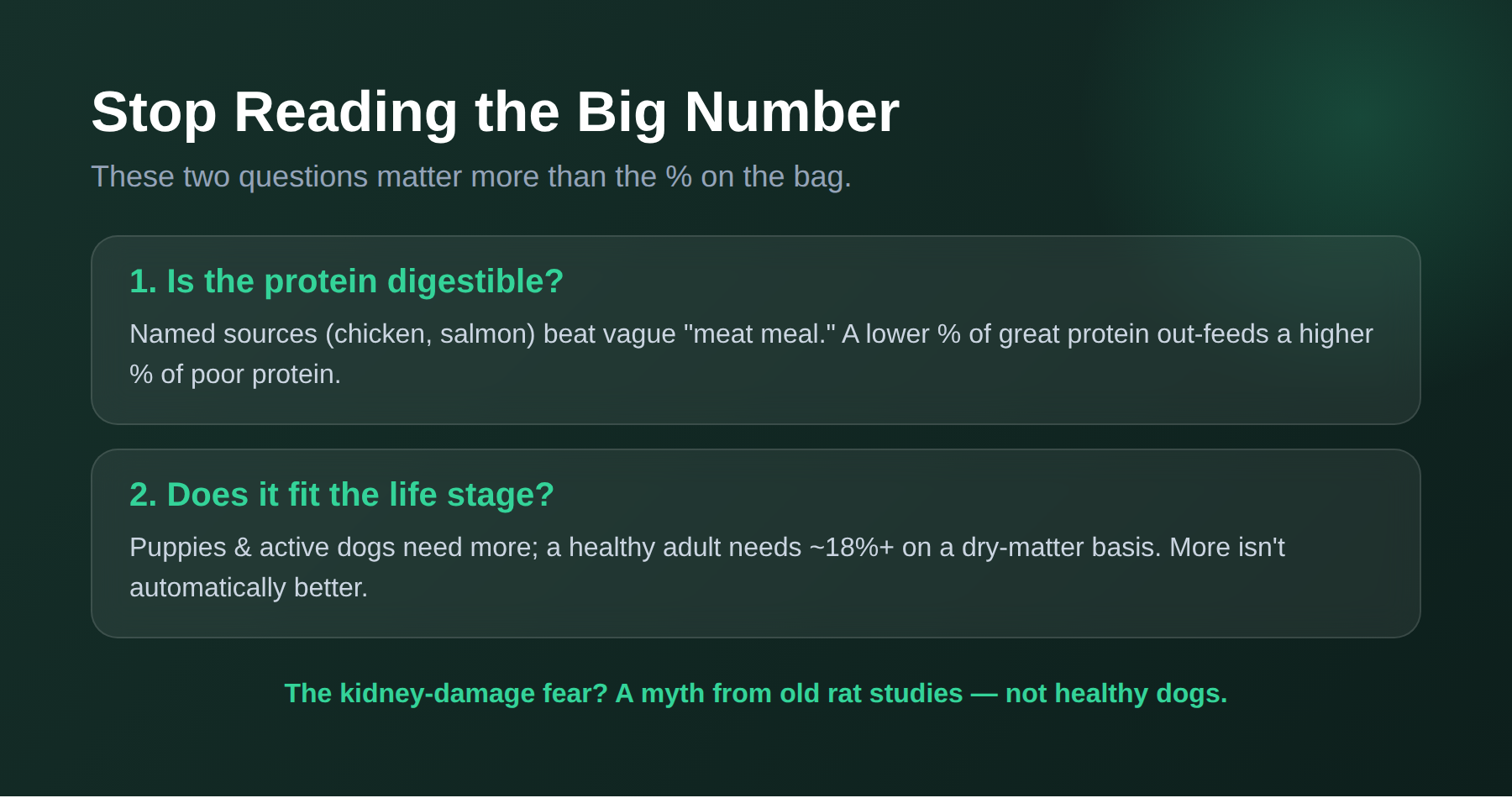
A lower number of great protein out-feeds a higher number of poor protein.
The Number Everyone Chases Is the Wrong One
Here’s what actually determines whether that protein helps your dog: can your dog digest and
use it? A bag boasting 30% protein from vague “meat meal” can deliver less usable nutrition
than a 24% food built on named chicken or salmon. The headline percentage counts the protein that’s
in the bag — not the protein your dog’s body can actually absorb.
And there’s a measurement trick that fools almost everyone: moisture. A wet food listed
at 9% protein isn’t weaker than a dry food at 26% — once you strip out the water, that wet food can
actually be the more protein-dense recipe. Comparing the front-of-bag numbers directly is
comparing two things measured on different scales.
The Myth That Won’t Die: “Protein Wrecks Kidneys”
Let’s put this one down for good.
The belief that high protein damages healthy kidneys traces back to old rat studies —
not dogs. It stuck around because dogs with already-diagnosed kidney disease are often put on
controlled-protein diets. But that’s disease management, not prevention.
A healthy dog does not protect its kidneys by eating less protein — any more than you protect your
knees by walking less. Research simply hasn’t shown high protein to harm dogs with normal kidney
function.
In fact, cutting protein too low backfires: the body starts breaking down its own muscle to
compensate. For most healthy dogs, a generous amount of quality protein isn’t a risk — it’s the goal.
So What Should You Actually Look For?
🐾 Reading a dog food label like you mean it
- Named sources first. “Chicken,” “salmon,” “lamb” — specific and near the top of the ingredient list — beat vague “meat and bone meal.”
- Convert for moisture before comparing. Wet and dry foods aren’t comparable at face value. Look for “dry matter basis” protein, or do the quick math.
- Match the life stage. Puppies and active dogs need more (around 22–25%+); a healthy adult needs roughly 18%+ on a dry-matter basis. Seniors shouldn’t be starved of it either.
- Don’t fear by-products reflexively. Organ by-products (liver, heart) are genuinely nutritious — it’s the vague, unnamed sourcing that’s the red flag, not the word itself.
The honest line: the kidney myth applies to healthy dogs. Dogs with existing
kidney or liver disease genuinely may need controlled-protein therapeutic diets — but that’s a
prescription your vet makes, not a reason for healthy dogs to eat less. When in doubt about your
individual dog, ask your vet.
The Bottom Line
- The big protein % on the bag matters less than digestibility and source quality.
- Moisture distorts the number — always compare on a dry-matter basis.
- “High protein damages kidneys” is a myth for healthy dogs, born from old rat studies.
- Chase named, digestible protein matched to life stage — not the biggest headline number.
Stop chasing the big number.
Chase the usable one.
Here to help you care smarter — not spend more. 🐾
How Much Protein Does Your Dog Actually Need?
Chasing digestibility instead of the front-of-bag number is the right instinct. But most owners still have no idea what the actual floor is — so here it is, straight from the people who set it.
AAFCO (the body whose nutrient profiles most “complete and balanced” claims are built on) sets two different minimums depending on life stage, measured on a dry-matter basis:
- Adult maintenance: at least 18% protein (45 g per 1,000 kcal of metabolizable energy)
- Growth and reproduction (puppies, pregnant or nursing dogs): at least 22.5% protein (56.3 g per 1,000 kcal)
Those are floors, not targets — most reputable adult maintenance foods run well above 18% in practice, often into the mid-20s to low-30s on a dry-matter basis. The point of knowing the floor isn’t to hit it exactly. It’s to recognize when a food is dangerously close to it, or marketed as “complete and balanced” for a life stage it doesn’t actually cover.
One label detail worth checking: the nutritional adequacy statement. It should say which life stage the food is formulated for — “growth,” “maintenance,” or “all life stages.” A food labeled only for adult maintenance is not automatically appropriate for a growing puppy, regardless of how high its protein percentage looks on the bag.
There’s no separate “senior” protein minimum
AAFCO doesn’t publish a distinct senior nutrient profile — “senior” formulas are adult maintenance foods with marketing and, often, adjusted calorie density, joint support, or fiber. This matters directly for the kidney myth already covered above: there’s no regulatory basis for feeding an older, healthy dog less protein than an adult-maintenance minimum. The exception remains dogs with a veterinarian-diagnosed kidney or liver condition, where a prescription therapeutic diet changes the calculation for medical reasons — not because of age alone.
Putting the number into daily grams — a worked example
Percentages are hard to picture; grams on a plate are not. Take a 20 kg (44 lb) adult dog eating a typical maintenance diet around 1,000 kcal a day. At the AAFCO adult-maintenance floor of 45 g protein per 1,000 kcal, that dog’s minimum protein intake is roughly 45 grams a day — for reference, a 3 oz (85 g) serving of cooked chicken breast contains roughly 25 grams of protein, so the floor alone is the rough equivalent of about two servings that size, before accounting for anything else in the diet. Most complete commercial diets clear this floor comfortably; the calculation is most useful as a sanity check on home-prepared or unusually low-protein commercial diets, not something to recalculate for every bag of standard kibble.
Not all protein sources digest the same way
The label lists ingredients by pre-cooking weight, not by how usable the protein actually is once digested — which is the entire point this article opened with. Named muscle meats (chicken, beef, salmon) and eggs tend to have high digestibility. Named meat meals (a rendered, concentrated protein source, distinct from vague “meat by-products”) can also be high quality despite sounding less appetizing on a label. Plant proteins can contribute meaningfully to a balanced diet but are generally less completely digestible for dogs than animal sources and may need to be paired carefully to supply all essential amino acids — a detail a home-prepared diet should get from a board-certified veterinary nutritionist rather than a general recipe found online.
A quick gut-check before switching foods over protein alone
If a dog is doing well — good coat, stable weight, normal energy, no digestive issues — a lower-percentage food that clears the AAFCO floor with quality named protein sources is not automatically worth switching away from just because a competitor’s bag advertises a bigger number. Conversely, a dog showing poor coat condition, muscle loss, or chronically low energy despite eating a diet that looks adequate on paper is a reason to loop in a veterinarian rather than simply buying a higher-percentage bag and hoping — because at that point, digestibility, an underlying health issue, or a mismatch between calories and activity level are all more likely explanations than the protein percentage itself.
Where fat and carbohydrates fit into the same conversation
Protein gets most of the attention on a dog food label, but it doesn’t exist in isolation — fat content drives a large share of a food’s calorie density, and carbohydrate sources fill much of the remaining formulation. A food can be technically adequate in protein while still being a poor fit for an individual dog’s calorie needs, activity level, or specific health conditions. The protein percentage is one input into a much larger nutritional picture, not a standalone verdict on whether a food is “good” or “bad” for a given dog.
Reading a bag with all of this in mind — life stage, digestibility signals, and the food’s place in overall diet and activity needs — replaces the single-number shortcut with a genuinely more useful set of questions to bring to a next food purchase or a conversation with your veterinarian. It also means two dogs eating visibly different foods can both be well-fed, and two dogs eating the same food can have very different outcomes depending on their individual digestion, activity, and health status. The number on the front of the bag was never going to answer that question by itself, and now it doesn’t have to.
For general information only; not a substitute for veterinary care. Dogs with diagnosed kidney or
liver disease may require veterinary therapeutic diets. Background drawn from veterinary and
pet-nutrition references including the AKC, veterinary nutritionists, and Dog Food Advisor guidance
on canine protein requirements.
How this article is checked. Every claim in this article goes through a structured evidence review before publishing: checked against veterinary guidelines (AAHA, WSAVA, AVMA) and peer-reviewed veterinary research, graded for how strong the evidence actually is, and screened for overstated or missing context. Articles that don't clear this review are not published. This is general educational information, not a substitute for professional veterinary advice — always consult your vet about your individual dog.
2 Comments
Comments are closed.