Your Dog Isn’t Misbehaving When You Leave — It’s Panicking
The chewed door frame. The neighbor’s noise complaint. The puddle by the entrance. Everyone told you: train harder, be firmer, tire the dog out. So you did — and nothing changed.
Here’s why. If your dog has true separation anxiety, more obedience training doesn’t just fail — it
can make things worse. Because you’d be treating the wrong problem entirely.
This isn’t a discipline problem. It’s a panic disorder.
Researchers who scan dogs’ brains have found activity, when dogs are with their person, in brain
regions similar to those involved in human attachment. When a truly anxious dog is left alone, it isn’t “acting out” — it’s experiencing
genuine panic: racing heart, a flood of stress hormones, an inability to self-settle. Punishing that,
or drilling “sit-stay,” is like scolding someone mid-panic-attack for not being calmer.
First: Is It Actually Anxiety? Or Just Boredom?
This is the fork in the road, and almost everyone gets it wrong. A bored dog and a panicking dog
can both wreck your living room — but they need opposite solutions. The fastest way to tell them
apart costs nothing: film your dog for the first 30 minutes after you leave.
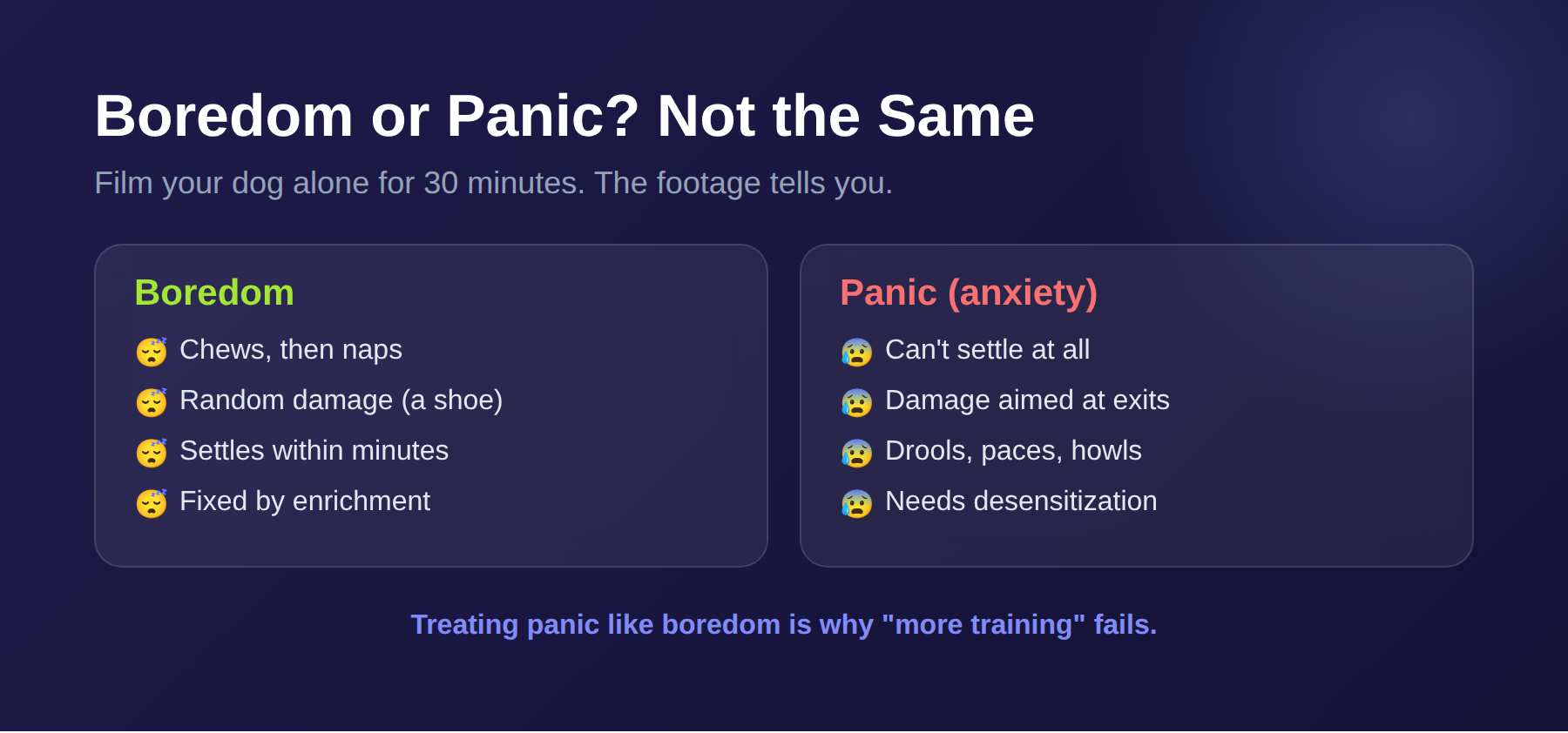
A bored dog gets into mischief, then gets over it — a chewed shoe here, a nap there. A panicking
dog can’t settle at all: it drools, paces, howls, and claws at the exits specifically — the
door, the window — trying to reunite with you. That detail matters. Random destruction is boredom.
Destruction aimed at escape routes is anxiety.
A panicking dog needs to feel safe alone.
Give an anxious dog “more exercise and a puzzle toy” and you’ll exhaust the body while the
fear stays untouched. Helpful for boredom. Beside the point for panic.
The Advice That Actually Backfires
You’ve probably been told to “desensitize your dog to your keys.” That’s the wrong target.
Picking up your keys only frightens your dog because of what it predicts: you leaving. Practicing
grabbing keys and setting them down again treats the symptom, not the fear. It’s like trying to cure
someone’s fear of water by having them open and close the pool gate.
The real work is desensitizing the dog to the actual separation — being alone —
in doses so small the panic never switches on.
What Real Treatment Looks Like
It’s unglamorous, and it works. The method is graduated desensitization: you find the
duration your dog can handle before distress begins — for some dogs that’s minutes, for
others just seconds — and you practice absences shorter than that, many times, so the dog banks
calm experiences instead of rehearsing panic.
🐾 The real approach (in plain terms)
- Find the threshold. How long can your dog be alone before it starts to unravel? Start just under that.
- Stay under it, build slowly. Short absences, repeated, extended in tiny steps. Blowing past the threshold rehearses the panic — it doesn’t build tolerance.
- Don’t leave the dog alone beyond its limit while you train — that undoes the work. This often means sitters, daycare, or adjusting your schedule at first.
- For moderate-to-severe cases, ask a vet about medication. It lowers the panic baseline so the training can actually take hold — it’s not a cop-out, it’s what makes the rest work.
The honest line: genuine separation anxiety is tough to fix alone, and crating an
anxious dog can make panic (and injury from escape attempts) worse. If your dog self-injures,
can’t be left at all, or you’re overwhelmed, get a vet or a certified separation-anxiety trainer
involved. This is a treatable condition — but it’s a real one.
The Bottom Line
- True separation anxiety is panic, not disobedience — and more training can worsen it.
- Film your dog to tell panic (can’t settle, targets exits) from boredom (mischief, then naps).
- The fix is graduated desensitization to being alone — not to your keys.
- Severe cases often need a vet and possibly medication to make training work.
Stop training the panic.
Start dissolving it.
Here to help you care smarter — not spend more. 🐾
The Graduated Protocol Vets Actually Recommend
Knowing that it’s panic, not disobedience, changes what “training harder” should mean. The evidence-based approach isn’t more obedience work — it’s systematic desensitization to the specific triggers that predict departure.
Step 1: Identify the pre-departure cues
Before addressing the actual absence, identify what your dog has learned to associate with you leaving — picking up keys, putting on shoes, grabbing a bag. Dogs with separation anxiety often begin showing distress at these cues, well before the door closes.
Step 2: Decouple the cues from departure
Practice the cue without leaving — pick up your keys and sit back down, put on your shoes and stay in the house. Repeated enough times, without a departure following, the cue gradually stops predicting panic.
Step 3: Build absence tolerance in small increments
Start with departures measured in seconds, not minutes — long enough that your dog notices you’re gone, short enough that you return before distress escalates. Increase duration gradually across sessions, based on your dog’s response, not a fixed schedule. This is slow work; rushing the timeline is the most common reason graduated protocols fail.
Step 4: Know when the protocol alone isn’t enough
For dogs with moderate to severe separation anxiety, behavior modification alone often isn’t sufficient — and that’s not a training failure. Veterinary behaviorists frequently combine graduated desensitization with anti-anxiety medication (prescription, veterinarian-managed) to bring a dog’s baseline anxiety down enough that the training can actually work. This isn’t a shortcut or a last resort; for many dogs it’s what makes the behavioral protocol possible at all.
Do not use crating as a first-line fix for a dog with true separation anxiety unless a veterinary behaviorist has specifically recommended it for that individual dog — for some dogs, confinement intensifies rather than reduces panic.
Setting up the environment while you work the protocol
A few practical changes support the graduated protocol without replacing it. A safe, comfortable space with familiar bedding and a piece of recently worn clothing can help, though it’s a comfort measure, not a fix on its own. Leaving genuinely engaging food puzzles or long-lasting chews at the moment of departure can help some dogs, but not dogs whose anxiety is severe enough that they won’t eat while distressed — offering food is a signal to watch, not force. A video camera that lets you observe your dog’s actual behavior while alone is genuinely useful: many owners are surprised to learn their dog settles within minutes, or conversely, discover the distress is worse and longer-lasting than they assumed from the destruction alone.
Why relapses happen even with a good protocol
Progress with separation anxiety is rarely a straight line. A schedule disruption, a house move, a change in household members (human or animal), or even an unrelated stressful event can set a dog back to an earlier stage in the protocol. This isn’t a sign the approach failed — it’s a normal part of the process, and the response is to temporarily shorten departure durations again rather than abandon the method or assume the dog is untrainable.
How long does the graduated protocol typically take?
There’s no universal timeline — mild cases can show meaningful improvement within a few weeks of consistent practice, while more severe cases, especially those also using medication, often take several months of steady, patient work. Progress is usually measured in the dog tolerating gradually longer absences without the panic signs (destruction, house-soiling, excessive vocalization) returning, not in a single dramatic turning point. Owners who expect a fast fix are often the ones who accidentally rush the duration increases and trigger the relapse pattern described above — slow, boring, consistent practice is what actually works here, even though it’s the least exciting advice to follow.
What NOT to expect from the protocol
A graduated desensitization plan is not designed to eliminate every trace of a dog missing their owner — some baseline attachment and mild adjustment period after departure is normal and not a sign of failure. The goal is reducing true panic to a manageable level, not producing complete indifference to being left alone, which isn’t a realistic or necessary outcome for a socially bonded animal.
Consistency across the household extends here too: if one family member sneaks back early to check on a distressed dog while another sticks to the planned duration, the inconsistency itself can undermine the dog’s ability to learn that departures reliably end in a return. Owners who track weekly rather than daily progress tend to stay more realistic about the pace, since day-to-day variation is normal even when the overall trend is genuinely improving. Small, boring, repeated wins really are the whole strategy here.
For general information only; not a substitute for veterinary or professional behavioral care. If
your dog shows severe distress or self-injury when alone, consult a veterinarian or certified
separation-anxiety behavior consultant. Background drawn from veterinary-behavior and training
references including the AKC, certified separation-anxiety trainers, and canine behavior guidance.
How this article is checked. Every claim in this article goes through a structured evidence review before publishing: checked against veterinary guidelines (AAHA, WSAVA, AVMA) and peer-reviewed veterinary research, graded for how strong the evidence actually is, and screened for overstated or missing context. Articles that don't clear this review are not published. This is general educational information, not a substitute for professional veterinary advice — always consult your vet about your individual dog.