
Your Dog’s Fish Oil Might Be Rancid (and Why That’s Worse Than None)
You added fish oil to the bowl to fight inflammation, ease joints, shine the coat. Good move — if the oil is fresh. If it’s not, you may be feeding the exact opposite of what you paid for.
This is the part the omega-3 aisle never advertises: fish oil is one of the most fragile supplements
there is, and a startling amount of it is already spoiled. A 2023 study out of George Washington
University, published in the Journal of Dietary Supplements, tested 72 popular omega-3
brands and found 45% tested positive for rancidity. Nearly one in two. That study
tested human supplement brands, not pet-specific ones — but the oil chemistry is identical, and
pet supplements are, if anything, less scrutinized, not more.
Rancid fish oil isn’t just weaker. It actively works against your dog.
Why “Healthy” Fish Oil Can Turn on Your Dog
Omega-3s are packed with reactive double bonds — the very thing that makes them useful in the body
also makes them oxidize the instant they meet heat, light, or air. When they oxidize, they don’t just
lose potency. They generate free radicals and lipid peroxides — unstable molecules that drive the
very inflammation you were trying to fight.
Rancid omega-3 can feed it.
Research in animals links oxidized oils to worsened arthritis and allergies — the exact
problems owners buy fish oil to help. That’s why experts say it plainly: rancid fish oil is worse
than no fish oil at all.
The Trap: You Can’t Smell the Damage in Time
“It doesn’t smell fishy, so it’s fine” is the mistake that gets almost everyone.
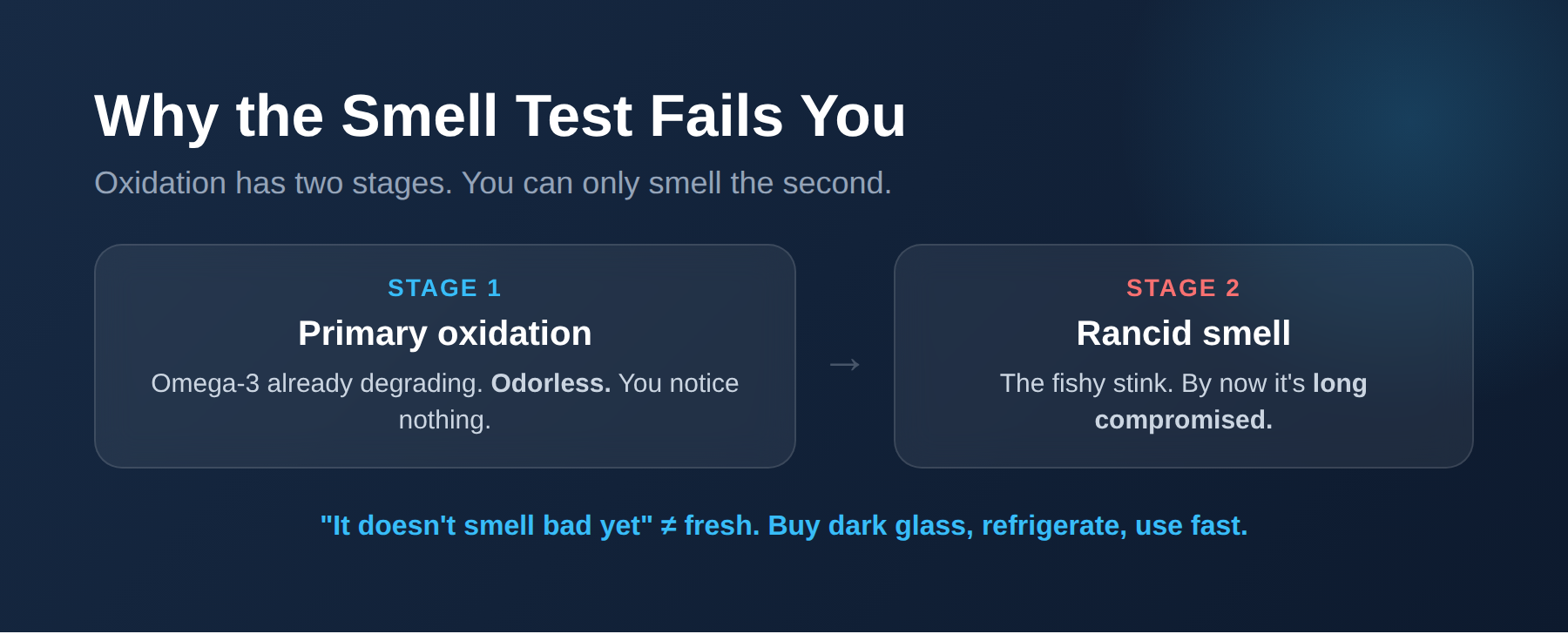
Oxidation happens in two stages. The first stage — where the omega-3s are already
degrading — is essentially odorless. The fishy, sour “rancid” smell you’re waiting for is the
second stage, by which point the oil has been compromised for a while. So the smell test,
the one thing everyone relies on, only warns you long after the damage is done. This is exactly the
lesson from the joint-supplement piece: the popular product can quietly be the useless — or
harmful — one.
The industry actually has a freshness number: TOTOX (total oxidation value). Fresh oil
sits low; the accepted industry ceiling is around 26. The catch — it’s rarely printed on the label.
For a dog with inflammatory issues, the only truly reliable way to verify freshness is to ask the
manufacturer for a Certificate of Analysis showing the TOTOX value. A brand that won’t share one is
telling you something.
How to Actually Keep It Fresh
🐾 Getting omega-3 right
- Buy dark glass, not clear plastic. Light and oxygen are the enemies; air even seeps through plastic. Small bottles you’ll finish quickly beat a big-value jug that oxidizes for months.
- Refrigerate after opening; freeze gel caps for longer life. Heat accelerates everything.
- Use it fast. Once opened, the clock is running. A bottle that lingers for months is a bottle going off.
- Look for third-party testing / published oxidation values — and if it ever smells sour or sharp, bin it. That smell means stage two.
The honest line: fresh omega-3 is genuinely one of the best-supported supplements for
dogs — this isn’t a reason to stop, it’s a reason to buy and store it properly. If your dog has
pancreatitis or another condition, talk to your vet before adding any oil, and ask about dose. Fresh
and correctly dosed is the whole point.
The Bottom Line
- Nearly half of omega-3 supplements test as rancid — and rancid oil can feed inflammation.
- The smell test fails: early (odorless) oxidation happens before any fishy smell appears.
- Freshness has a number (TOTOX); ask for a Certificate of Analysis for at-risk dogs.
- Buy dark glass, refrigerate, use fast — fresh omega-3 is excellent; rancid is worse than none.
You didn’t buy inflammation.
Make sure you’re not feeding it.
Here to help you care smarter — not spend more. 🐾
How Much Fish Oil Actually Helps
Freshness only matters if the dose was worth protecting in the first place. Veterinary dosing guidance for general anti-inflammatory support generally falls in the range of 40–75 mg of combined EPA+DHA per kg of body weight per day, scaling toward the higher end (and sometimes further, under veterinary guidance) for confirmed inflammatory conditions like osteoarthritis or atopic dermatitis.
For a 10 kg (22 lb) dog, that’s roughly 400–750 mg of combined EPA+DHA daily — not a full teaspoon of generic “salmon oil” poured on top of the bowl with no label math behind it. The NRC’s safe upper limit for dogs is 280 mg of EPA+DHA per 100 kcal of diet; more is not automatically more effective, and very high, unsupervised doses can affect platelet function and digestion.
What you can actually check for freshness at home
Industry testing for rancidity uses lab measures — Peroxide Value, p-Anisidine Value, and a combined TOTOX score — that aren’t something a kitchen can replicate. But a few practical checks are genuinely useful:
- Smell it before every use, not just at purchase. Fresh fish oil smells mild and faintly marine. A sharp, “old paint” or distinctly fishy-sour smell is oxidation, not just “how fish oil smells.”
- Refrigerate after opening, even if the label doesn’t explicitly require it before opening — oxidation accelerates with heat, light, and air exposure the moment the seal is broken.
- Watch the clock, not just the smell. Oxidation can outpace your nose. Most opened liquid fish oil is best used within 60–90 days even when it still smells acceptable; check the manufacturer’s specific guidance.
- Prefer smaller bottles over “value size” if your dog is small — a large bottle that takes four months to empty for a 5 kg dog spends most of that time oxidizing before it’s used up.
Rancid fish oil isn’t just less beneficial — the oxidized fatty acids it contains behave as pro-inflammatory compounds, which is the opposite of the reason most owners add it to the bowl in the first place.
Starting fish oil without upsetting a dog’s stomach
Fish oil is, after all, added fat — and introducing a meaningful amount of any new fat too quickly is a common, avoidable cause of loose stool or a bout of pancreatitis-like discomfort in sensitive dogs. Starting at a fraction of the target dose and increasing gradually over one to two weeks gives the digestive system time to adjust, and is a more reliable way to avoid GI upset than starting at full dose and hoping for the best.
Situations where a vet conversation should come first
Fish oil isn’t universally risk-free. Dogs with a history of pancreatitis, dogs on blood-thinning medication, and dogs scheduled for surgery in the near future are all situations where the added fat load or the mild effect on platelet function is worth discussing with a veterinarian before starting or continuing a fish oil supplement — not because the supplement is dangerous by default, but because these are exactly the situations where its known effects intersect with an existing vulnerability.
Reading the label’s “best by” date correctly
A best-by date reflects the unopened product stored as directed — it does not reset once the bottle is opened, and most manufacturers’ guidance for use-after-opening is considerably shorter than the printed date might suggest at a glance. Writing the open date directly on the bottle with a marker is a small habit that removes the guesswork later, since “I think I opened this a couple months ago” is exactly the kind of vague timeline that leads to a bottle being used well past when it stopped being fresh.
Capsules versus liquid — a freshness trade-off
Capsule-form fish oil is somewhat more protected from oxygen exposure than an open liquid bottle exposed to air with every use, which can make capsules a more forgiving option for households that go through a bottle slowly, or for smaller dogs where a full liquid bottle takes a long time to empty. Liquid remains easier to dose precisely by weight and is often preferred for larger dogs needing a bigger daily volume — neither format is universally better, but the freshness trade-off is worth factoring into which one actually fits a specific dog’s size and household habits.
None of this needs to become a complicated ritual — a consistent smell-check, a written open date, and reasonable storage cover most of what actually matters for keeping the supplement doing what it’s meant to do. Treating fish oil with the same basic food-safety awareness applied to any perishable product in the kitchen is really all that’s being asked here, nothing more elaborate than that.
For general information only; not a substitute for veterinary care. Dogs with pancreatitis or other
conditions should start any oil supplement only under veterinary guidance. Background drawn from
veterinary and nutrition references including the 2023 George Washington University omega-3
rancidity analysis (human supplement market; cited here for oxidation chemistry, not a pet-specific
finding), GOED/TOTOX industry standards, and veterinary fish-oil storage guidance.
How this article is checked. Every claim in this article goes through a structured evidence review before publishing: checked against veterinary guidelines (AAHA, WSAVA, AVMA) and peer-reviewed veterinary research, graded for how strong the evidence actually is, and screened for overstated or missing context. Articles that don't clear this review are not published. This is general educational information, not a substitute for professional veterinary advice — always consult your vet about your individual dog.
2 Comments
Comments are closed.