How to Switch Dog Food Without Ignoring a Real Stomach Problem
Most owners do not need a longer list of possibilities. They need to know which detail changes the next move. A gradual transition can reduce avoidable upset. It cannot make a poorly tolerated diet or an illness safe. This guide turns that distinction into an observation plan: what to notice, what you can change safely, and when the pattern belongs with your veterinarian or a qualified behavior professional.
Decide whether this is an elective switch
Changing a healthy dog’s food for convenience is different from changing because of vomiting, weight loss, suspected allergy, or a prescribed therapeutic diet. Watch for reason for the change, current symptoms, and whether a veterinarian directed the switch. The earliest change is usually more actionable than the loudest part of the event, because it shows where prevention was still possible.
get veterinary instructions first when disease or a therapeutic diet is involved. Then compare intensity, duration, and recovery with the previous occurrence. A generic transition schedule may be wrong for an acute medical problem. A plan earns another attempt only when the dog remains physically safe and the trend is stable or improving.
Use a gradual mix as a starting framework
Many dogs tolerate a change better when the new food increases over roughly a week rather than arriving in one meal. For an owner, the usable evidence is concrete: stool quality, appetite, vomiting, gas, comfort, and energy each day. Write those details down without deliberately recreating the problem. A natural event observed safely is enough.
The next move: increase the new proportion gradually and slow down if mild signs appear. This is a management or learning step, not proof of a diagnosis. There is no universal perfect ratio or schedule for every dog. When a physical sign appears alongside the pattern, the medical question moves ahead of further practice.
Change one variable when possible
New food plus new treats, chews, supplements, and table scraps creates an investigation with no clean answer. Do not judge it from one dramatic snapshot. Instead, compare every edible item introduced during the same period. Context can change the meaning of the same outward behavior.
A reasonable first response is to keep extras stable and log the exact product and amount. Give that change a fair but safe trial, and stop before distress or injury becomes the price of information. Medication and scavenging can also affect the gut. Improvement should look like easier recovery, not mere suppression.
Measure the new food by calories, not volume alone
Different foods can have very different calorie density. Matching cup for cup may accidentally overfeed or underfeed. The distinction becomes clearer when you track kilocalories per cup or kilogram and the dog’s existing daily intake. This is especially useful when several people handle the dog and remember the event differently.
Practical decision: calculate a starting portion with veterinary guidance and weigh food when practical. Change only what the dog can tolerate without force. Label feeding directions are estimates, not an individualized prescription. If the household cannot maintain that boundary consistently, professional help becomes part of risk management rather than a last resort.
Interpret mild loose stool in context
A single soft stool in an otherwise bright dog differs from repeated watery diarrhea with weakness or vomiting. Before adding a product or a harder exercise, look at frequency, volume, blood, mucus, straining, appetite, water intake, and behavior. These signs tell you whether the present setup is workable.
hold at the current transition step or contact the veterinarian if signs persist. Recheck the same markers afterward instead of relying on whether the dog simply became quieter. Do not use human antidiarrheal medication unless a veterinarian directs it. Quiet behavior can reflect comfort, fatigue, freezing, or learned inhibition; the surrounding pattern decides which explanation is plausible.
Know when to stop the experiment
Repeated vomiting, significant diarrhea, blood, pain, refusal to eat, or lethargy shifts the problem from routine transition to medical assessment. The details worth capturing are hydration, gum moisture, weakness, abdominal posture, and ability to keep water down. Those observations describe a sequence rather than forcing one moment into a diagnosis. Note what changed first and how long the dog needed to return to baseline.
Start here: call the veterinary clinic promptly and follow their feeding instructions. Keep the setup easy enough that safety and choice remain intact. Puppies, seniors, and medically fragile dogs can deteriorate faster. If the response worsens after the change, undo the added difficulty and reassess the premise.
Do not diagnose food allergy from a rough switch
Itching or digestive signs after a food change can have several causes. A proper elimination diet is controlled and usually veterinarian-directed. Watch for timing, prior exposures, skin signs, ear disease, and response to a strict trial. The earliest change is usually more actionable than the loudest part of the event, because it shows where prevention was still possible.
avoid serial retail food hopping and discuss a diagnostic plan. Then compare intensity, duration, and recovery with the previous occurrence. Improvement after one switch does not prove which ingredient caused the problem. A plan earns another attempt only when the dog remains physically safe and the trend is stable or improving.
Store and handle food as part of the test
Moisture, heat, pests, rancidity, and cross-contamination can complicate interpretation. For an owner, the usable evidence is concrete: expiration, bag integrity, odor, storage conditions, and when the bag was opened. Write those details down without deliberately recreating the problem. A natural event observed safely is enough.
The next move: keep food in its original bag inside a clean container and preserve lot information. This is a management or learning step, not proof of a diagnosis. Report suspected product problems to the manufacturer and veterinarian. When a physical sign appears alongside the pattern, the medical question moves ahead of further practice.
Finish with a two-week reality check
Once the transition is complete, judge more than the first normal stool. Do not judge it from one dramatic snapshot. Instead, compare stable appetite, stool, body condition, skin, energy, and practical feeding fit. Context can change the meaning of the same outward behavior.
A reasonable first response is to record the product, daily grams, treats, and observations for future visits. Give that change a fair but safe trial, and stop before distress or injury becomes the price of information. A food that is fashionable is not automatically a better fit. Improvement should look like easier recovery, not mere suppression.
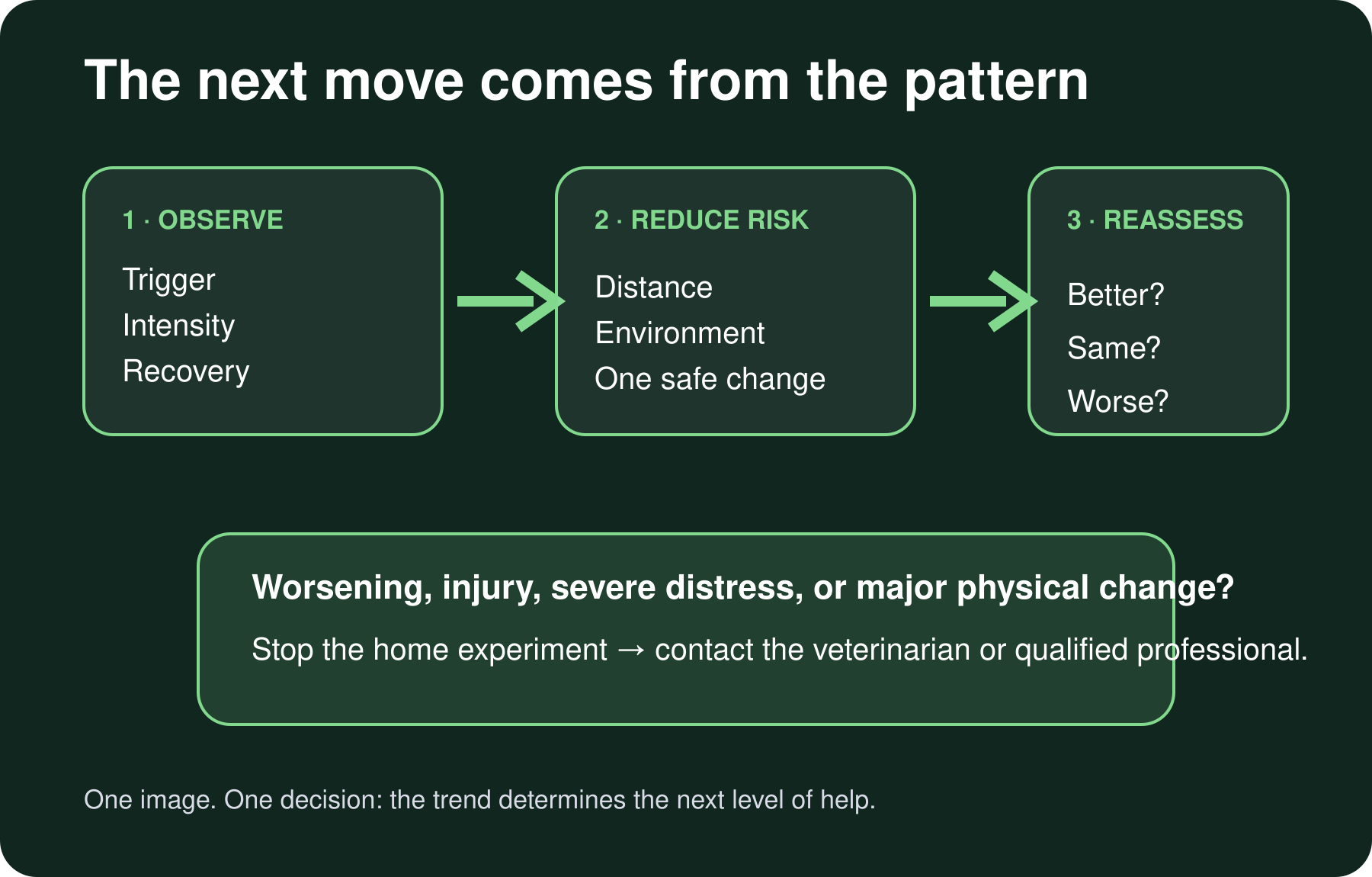
Your decision map
For how to switch dog food without diarrhea, the sequence below keeps action attached to evidence instead of a guess. Its fixed point is simple: A gradual transition can reduce avoidable upset. It cannot make a poorly tolerated diet or an illness safe.
- Decide whether this is an elective switch: get veterinary instructions first when disease or a therapeutic diet is involved. Reassess by watching reason for the change, current symptoms, and whether a veterinarian directed the switch.
- Use a gradual mix as a starting framework: increase the new proportion gradually and slow down if mild signs appear. Reassess by watching stool quality, appetite, vomiting, gas, comfort, and energy each day.
- Change one variable when possible: keep extras stable and log the exact product and amount. Reassess by watching every edible item introduced during the same period.
- Measure the new food by calories, not volume alone: calculate a starting portion with veterinary guidance and weigh food when practical. Reassess by watching kilocalories per cup or kilogram and the dog’s existing daily intake.
- Interpret mild loose stool in context: hold at the current transition step or contact the veterinarian if signs persist. Reassess by watching frequency, volume, blood, mucus, straining, appetite, water intake, and behavior.
- Know when to stop the experiment: call the veterinary clinic promptly and follow their feeding instructions. Reassess by watching hydration, gum moisture, weakness, abdominal posture, and ability to keep water down.
If these steps cannot be carried out without triggering reason for the change, current symptoms, and whether a veterinarian directed the switch, stop increasing the challenge. That result is enough to justify a safer setup and a case-specific conversation; the dog does not need to fail more dramatically first.
Quick decision questions
Which change matters first?
For how to switch dog food without diarrhea, begin with this observable distinction: stool quality, appetite, vomiting, gas, comfort, and energy each day. The first low-risk response is to increase the new proportion gradually and slow down if mild signs appear. If that cannot be done without provoking the problem, move the case out of trial-and-error mode.
What belongs in the record?
Track frequency, volume, blood, mucus, straining, appetite, water intake, and behavior. Add the time needed to recover and any change in appetite, sleep, movement, elimination, or social behavior. Record naturally occurring events; do not stage a stronger version for the camera.
When does outside help move forward?
Report suspected product problems to the manufacturer and veterinarian. A useful handoff includes what triggered the event, what reduced it, and what happened after keep food in its original bag inside a clean container and preserve lot information.
What to bring to the next conversation
Bring a concise record tied to this article’s question: how to switch dog food without diarrhea. Include when the pattern began, the first observable change, the most difficult context, what reliably reduces intensity, how long recovery takes, and whether appetite, sleep, movement, elimination, breathing, or social behavior changed at the same time.
For “How to Switch Dog Food Without Ignoring a Real Stomach Problem,” list each management step already tried and what followed. That prevents a veterinary or behavior visit from beginning with vague descriptions such as “better” or “worse.” It also shows whether improvement followed the planned change or merely coincided with the trigger disappearing.
Keep the main conclusion visible while you collect details: A gradual transition can reduce avoidable upset. It cannot make a poorly tolerated diet or an illness safe. New information should refine that decision, not erase safety boundaries. If a recommendation depends on diagnosis, exercise capacity, calorie target, medication, or a controlled behavior setup, leave it with the professional who can examine the dog and review the history.
The AAHA Feeding Guidance source supports this decision framework, but guidance for a population cannot predict one dog’s outcome. Claim strength must remain unchanged after SEO, visual design, and editing. For how to switch dog food without diarrhea, the aim is a defensible next move—not a confident-sounding diagnosis.
Do not delay that conversation merely to complete a perfect record of stable appetite, stool, body condition, skin, energy, and practical feeding fit. Worsening signs, injury, severe distress, or loss of normal function deserves timely care with the information already available.
Sources
How this article is checked. Every claim in this article goes through a structured evidence review before publishing: checked against veterinary guidelines (AAHA, WSAVA, AVMA) and peer-reviewed veterinary research, graded for how strong the evidence actually is, and screened for overstated or missing context. Articles that don't clear this review are not published. This is general educational information, not a substitute for professional veterinary advice — always consult your vet about your individual dog.