
Your Dog’s Joint Supplement Isn’t Working. Here’s the Real Reason.
You’ve given the glucosamine every single day for two months. Your dog still takes the stairs like they hurt. So you assume it just “doesn’t work on him.”
Here’s the uncomfortable truth: the supplement most likely never had a fair chance — because two
things almost nobody tells you were working against it from day one.
The famous joint supplement has the shakiest evidence. And most bottles are underdosed.
Glucosamine is the name everyone knows. It’s on every “hip & joint” label, every senior-dog treat.
And that fame is exactly the problem — because fame and evidence turned out to be two very
different things.
The Uncomfortable Truth About the Famous One
When researchers actually put glucosamine and chondroitin under controlled trials, the results came
back — in the words of veterinary reviewers — “mixed” and “difficult to interpret.” Some studies
showed pain relief after 70 days. Others found no meaningful difference from a placebo. A
2023 placebo-controlled trial in dogs with hip osteoarthritis (published in Frontiers in
Veterinary Science) found glucosamine and chondroitin performed essentially like the sugar
pill, while marine-based fatty acid compounds and a prescription NSAID clearly beat it.
That doesn’t mean glucosamine is useless. It means it’s unreliable — and being
sold as a sure thing. Meanwhile, the ingredients with stronger evidence barely get
marketed, because they’re not the household name.
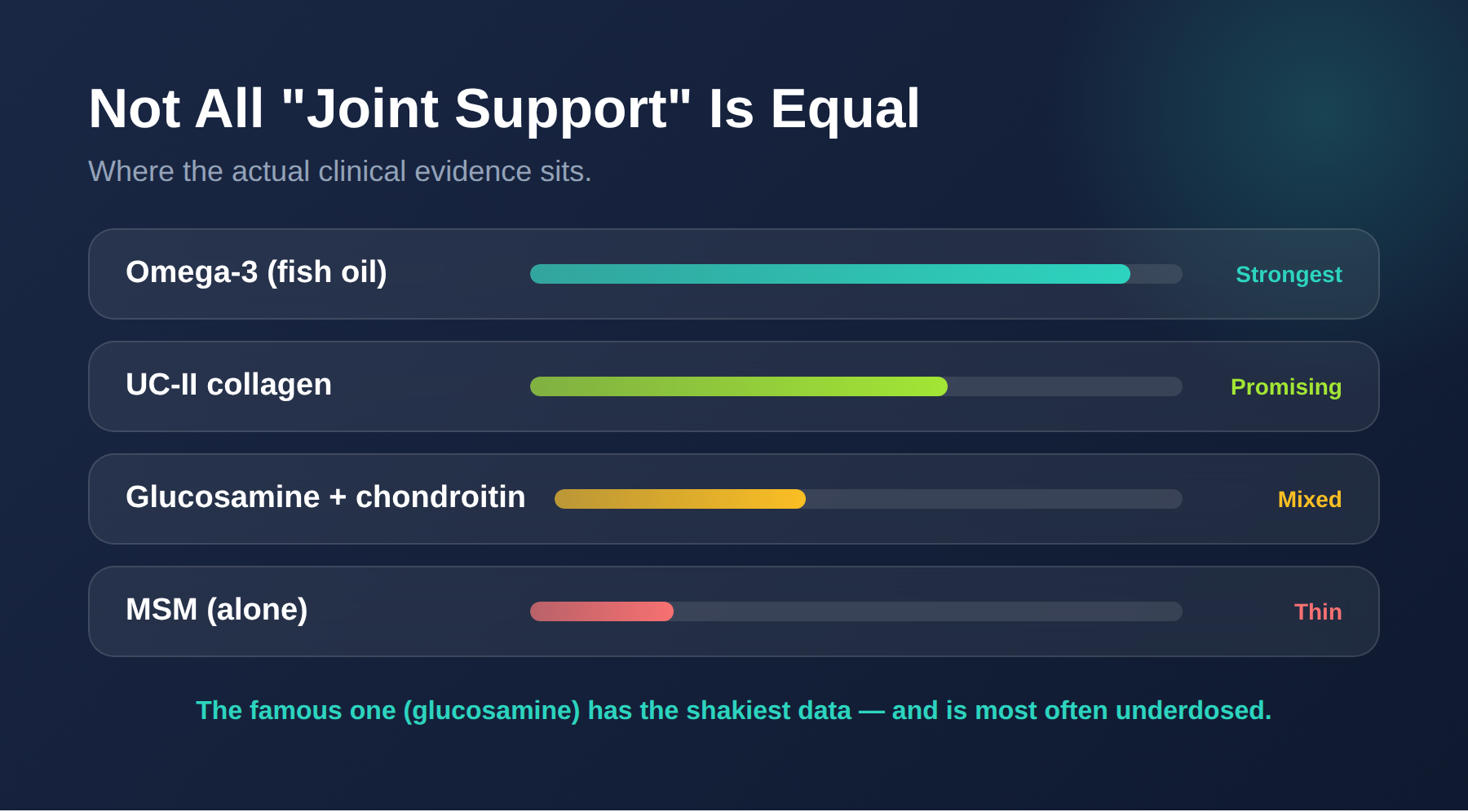
in head-to-head dog trials.
The same marine-based fatty acids people buy for a shiny coat have some of the strongest
joint evidence in dogs — and undenatured type II collagen (UC-II) is emerging as another
front-runner. The famous pill? Middle of the pack, at best.
The Second Trap: You’re Probably Giving Too Little
Even if glucosamine would help your dog, the dose in most products can’t get there.
This is the part that quietly wastes the most money. Common veterinary dosing guides put
research-level glucosamine at roughly 500 mg a day for a medium dog, climbing to 1,000 mg or more
for large and giant breeds — and some vets recommend a loading dose (a higher amount)
for the first several weeks before settling into a maintenance dose.
Now look at a typical “joint support” chew: often 100–300 mg per piece, sometimes with only
one or two recommended daily. For anything but a small dog, that can land well under the
research-level dose. So the owner gives it faithfully, sees nothing, and concludes the supplement
failed — when really it was never at a working dose in the first place. Check your dog’s actual
weight bracket against the label before assuming the ingredient itself doesn’t work.
Notice this is the same lesson as the probiotic story, just wearing a different coat. It’s not “do
supplements work?” It’s “which one, at what dose, for what problem?” A pinch of the trendy
ingredient does nothing. The right ingredient at the right amount is a different conversation
entirely.
Marketing sells the name. Results come from the dose and the evidence.
So What Actually Helps a Stiff Dog?
🐾 A smarter joint plan
- Start with omega-3 (fish oil), properly dosed. It has the strongest evidence and does double duty for skin and coat. Ask your vet for the EPA/DHA amount right for your dog’s weight.
- If you use glucosamine, dose it seriously. Check the actual milligrams, expect a loading period, and give it a fair 6–8 weeks — not a token chew.
- The two free interventions beat any pill: keeping your dog lean (extra weight is extra load on every joint) and steady, gentle exercise to hold muscle. No supplement outperforms these.
- Look for the NASC quality seal — supplements aren’t tightly regulated, and many contain less than the label claims.
The honest line: supplements support joints; they don’t reverse advanced
arthritis. If your dog is limping, reluctant to jump, or clearly in pain, that’s a vet visit —
there are prescription options far stronger than anything on a shelf, and pain deserves real
treatment, not just a chew.
The Bottom Line
- The most famous joint supplement (glucosamine) has the most mixed evidence.
- Omega-3 fish oil quietly has the strongest — and UC-II collagen is promising.
- Most products are badly underdosed, so they never get a fair test.
- The biggest wins are free: keep your dog lean and moving. See a vet for real pain.
Stop blaming the dog.
Fix the dose — or change the pill.
Here to help you care smarter — not spend more. 🐾
What “Underdosed” Actually Looks Like
The article’s core claim — that most products don’t dose enough to matter — is easy to say and hard to verify without a number to check against. Here’s the number.
For glucosamine and chondroitin, veterinary dosing guidance generally lands around 15–30 mg per kg of body weight for the chondroitin component (glucosamine is usually dosed to match). For a 20 kg (44 lb) dog, that’s roughly 300–600 mg of chondroitin daily — not the “sprinkle” amount some treats and chews actually contain once you read the guaranteed analysis on the back of the bag rather than the marketing on the front.
There’s also a loading-dose detail almost no product label mentions: glucosamine and chondroitin typically need to be given at roughly double the maintenance dose for the first four to six weeks to reach a therapeutic tissue level, before dropping to the regular maintenance dose. A dog started at maintenance dose from day one — which is how most owners use these products — may take considerably longer to show any benefit, if they show one at all.
| Dog weight | Approx. chondroitin (mg/day, maintenance) |
|---|---|
| 5 kg (11 lb) | 75–150 mg |
| 10 kg (22 lb) | 150–300 mg |
| 20 kg (44 lb) | 300–600 mg |
| 30 kg (66 lb) | 450–900 mg |
Reading a joint-supplement label like you mean it
- Find the chondroitin milligram amount per serving — not just “glucosamine chondroitin complex” as one vague line.
- Compare that number against the weight-based ranges above, not against how big the bottle looks.
- If the label doesn’t state a milligram amount per active ingredient at all, that itself is useful information.
- Ask whether a loading period is recommended — its absence isn’t necessarily wrong, but its presence is a good sign the formulation was designed around actual dosing evidence rather than a generic supplement template.
The supplement isn’t working alone anyway
Even a correctly dosed joint supplement is one piece of a larger picture, not a substitute for it. Excess body weight is one of the most modifiable contributors to joint stress in dogs — even a moderate weight reduction in an overweight dog can measurably ease osteoarthritis symptoms, sometimes as much as a supplement does on its own. Consistent, moderate low-impact exercise (steady walks rather than sporadic intense play) helps maintain muscle mass supporting the joints, while omega-3 fatty acids from fish oil have their own separate evidence base for reducing joint inflammation and are frequently used alongside — not instead of — glucosamine and chondroitin. A dog on the correct supplement dose, still overweight and sedentary, is unlikely to show the improvement the supplement alone is capable of producing.
What a vet adds that a supplement can’t
Supplements are, by design, gentler and slower-acting than prescription options. For a dog in significant pain, a veterinarian can offer a properly dosed anti-inflammatory or pain-management medication to bring comfort under control faster, then use supplements as part of longer-term maintenance — rather than asking a dog to wait weeks for a nutraceutical loading dose to take effect while still in daily discomfort. Persistent lameness, reluctance to move, or clear signs of pain are reasons to involve a vet in the plan, not just the pet-store aisle.
Signs the current plan genuinely isn’t working — versus just being early
Given the loading-dose timeline covered above, judging a joint supplement’s effectiveness before six to eight weeks of correct dosing have passed is premature. After that window, real signs of a plan that isn’t working include no change in stiffness after rest, continued reluctance on stairs or jumping, or new compensating behaviors like favoring one side. At that point, the right move isn’t switching to a different brand of the same ingredients — it’s a veterinary recheck to confirm the dose, reconsider the diagnosis, or discuss whether a prescription option belongs in the plan alongside the supplement rather than instead of a supplement that was never given a fair, correctly-dosed trial.
One more label detail worth a second look
Some products list a combined “glucosamine + chondroitin complex” total rather than breaking out each ingredient separately — a formatting choice that makes it harder to compare against the dosing ranges above. When possible, favor labels that state each active ingredient’s milligram amount individually.
For general information only; not a substitute for veterinary care. Limping, reluctance to move, or
signs of pain warrant a veterinary exam; prescription treatments exist that are more effective than
supplements. Supplements are not tightly regulated — product potency varies. Background drawn from
veterinary and pet-health references including dvm360, peer-reviewed canine osteoarthritis trials
(Frontiers in Veterinary Science), and veterinary supplement reviews.
How this article is checked. Every claim in this article goes through a structured evidence review before publishing: checked against veterinary guidelines (AAHA, WSAVA, AVMA) and peer-reviewed veterinary research, graded for how strong the evidence actually is, and screened for overstated or missing context. Articles that don't clear this review are not published. This is general educational information, not a substitute for professional veterinary advice — always consult your vet about your individual dog.
One Comment
Comments are closed.