When Fetch Winds a Dog Up Instead of Wearing Them Out
Most owners do not need a longer list of possibilities. They need to know which detail changes the next move. More repetitions can build more arousal. The missing skill may be recovery, not endurance. This guide turns that distinction into an observation plan: what to notice, what you can change safely, and when the pattern belongs with your veterinarian or a qualified behavior professional.
Look at the whole sequence
Fetch includes anticipation, sprinting, grabbing, returning, release, and restart. A problem can appear at any link. Do not judge it from one dramatic snapshot. Instead, compare barking before the throw, collisions, hard grabbing, refusal to release, and inability to stop. Context can change the meaning of the same outward behavior.
A reasonable first response is to identify the first point where control changes. Give that change a fair but safe trial, and stop before distress or injury becomes the price of information. A fast dog is not automatically an overstimulated dog. Improvement should look like easier recovery, not mere suppression.
Use recovery as the main metric
Endurance tells you how long a dog can continue; regulation tells you whether the dog can pause and settle. The distinction becomes clearer when you track breathing, body tension, response to a familiar cue, and time to relax. This is especially useful when several people handle the dog and remember the event differently.
Practical decision: insert short pauses before the dog loses responsiveness. Change only what the dog can tolerate without force. Do not demand stillness while the dog is physically overheated. If the household cannot maintain that boundary consistently, professional help becomes part of risk management rather than a last resort.
Reduce predictable physical risk
Repeated sharp turns, jumps, slippery footing, and high-speed stops can load the body. Before adding a product or a harder exercise, look at surface, throw direction, collisions, limping, and next-day stiffness. These signs tell you whether the present setup is workable.
use safer footing, lower trajectories, fewer repetitions, and warm-up movement. Recheck the same markers afterward instead of relying on whether the dog simply became quieter. Individual orthopedic risk requires veterinary guidance. Quiet behavior can reflect comfort, fatigue, freezing, or learned inhibition; the surrounding pattern decides which explanation is plausible.
Teach the end away from peak arousal
An all-done cue is easier to learn during short sessions than after dozens of frantic repetitions. The details worth capturing are whether the dog can release, take a drink, sniff, and move away from the launch point. Those observations describe a sequence rather than forcing one moment into a diagnosis. Note what changed first and how long the dog needed to return to baseline.
Start here: end early and transition to a lower-intensity activity. Keep the setup easy enough that safety and choice remain intact. Do not suddenly wrestle the ball away from a guarding dog. If the response worsens after the change, undo the added difficulty and reassess the premise.
Avoid using fetch as the only outlet
A dog can become extremely fit at the exact behavior that keeps the household busy. Watch for daily mix of exploration, chewing, social play, training, rest, and aerobic movement. The earliest change is usually more actionable than the loudest part of the event, because it shows where prevention was still possible.
balance fetch with sniffing and calmer problem-solving. Then compare intensity, duration, and recovery with the previous occurrence. Variety should serve the dog, not become a quota. A plan earns another attempt only when the dog remains physically safe and the trend is stable or improving.
Check heat and breathing
High-speed repetition can mask rising heat stress until the dog is already in trouble. For an owner, the usable evidence is concrete: temperature, humidity, shade, panting quality, coordination, gum color, and recovery. Write those details down without deliberately recreating the problem. A natural event observed safely is enough.
The next move: stop early, provide water and shade, and avoid hot conditions. This is a management or learning step, not proof of a diagnosis. Collapse, confusion, severe breathing difficulty, or suspected heatstroke is an emergency. When a physical sign appears alongside the pattern, the medical question moves ahead of further practice.
Separate arousal from compulsion claims
Persistent ball focus can be reinforced by the routine, but a remote label cannot establish a compulsive disorder. Do not judge it from one dramatic snapshot. Instead, compare ability to disengage in other contexts, sleep, appetite, injury, and interference with normal life. Context can change the meaning of the same outward behavior.
A reasonable first response is to discuss severe or pervasive patterns with the veterinarian. Give that change a fair but safe trial, and stop before distress or injury becomes the price of information. Do not diagnose obsession from enthusiasm alone. Improvement should look like easier recovery, not mere suppression.
Adapt the game across life stages
Puppies and seniors may need fewer repetitions, gentler surfaces, and more recovery than healthy adults. The distinction becomes clearer when you track growth stage, mobility, coordination, pain, and fatigue. This is especially useful when several people handle the dog and remember the event differently.
Practical decision: ask for an individualized exercise plan when health risk exists. Change only what the dog can tolerate without force. Age is only one part of capacity. If the household cannot maintain that boundary consistently, professional help becomes part of risk management rather than a last resort.
Design a better session
A practical session has a planned number of repetitions, built-in pauses, safe terrain, and a clear finish. Before adding a product or a harder exercise, look at quality of movement and recovery across the session. These signs tell you whether the present setup is workable.
stop while the dog is still coordinated and able to disengage. Recheck the same markers afterward instead of relying on whether the dog simply became quieter. The goal is a dog who can return to ordinary life, not one who is merely exhausted. Quiet behavior can reflect comfort, fatigue, freezing, or learned inhibition; the surrounding pattern decides which explanation is plausible.
Your decision map
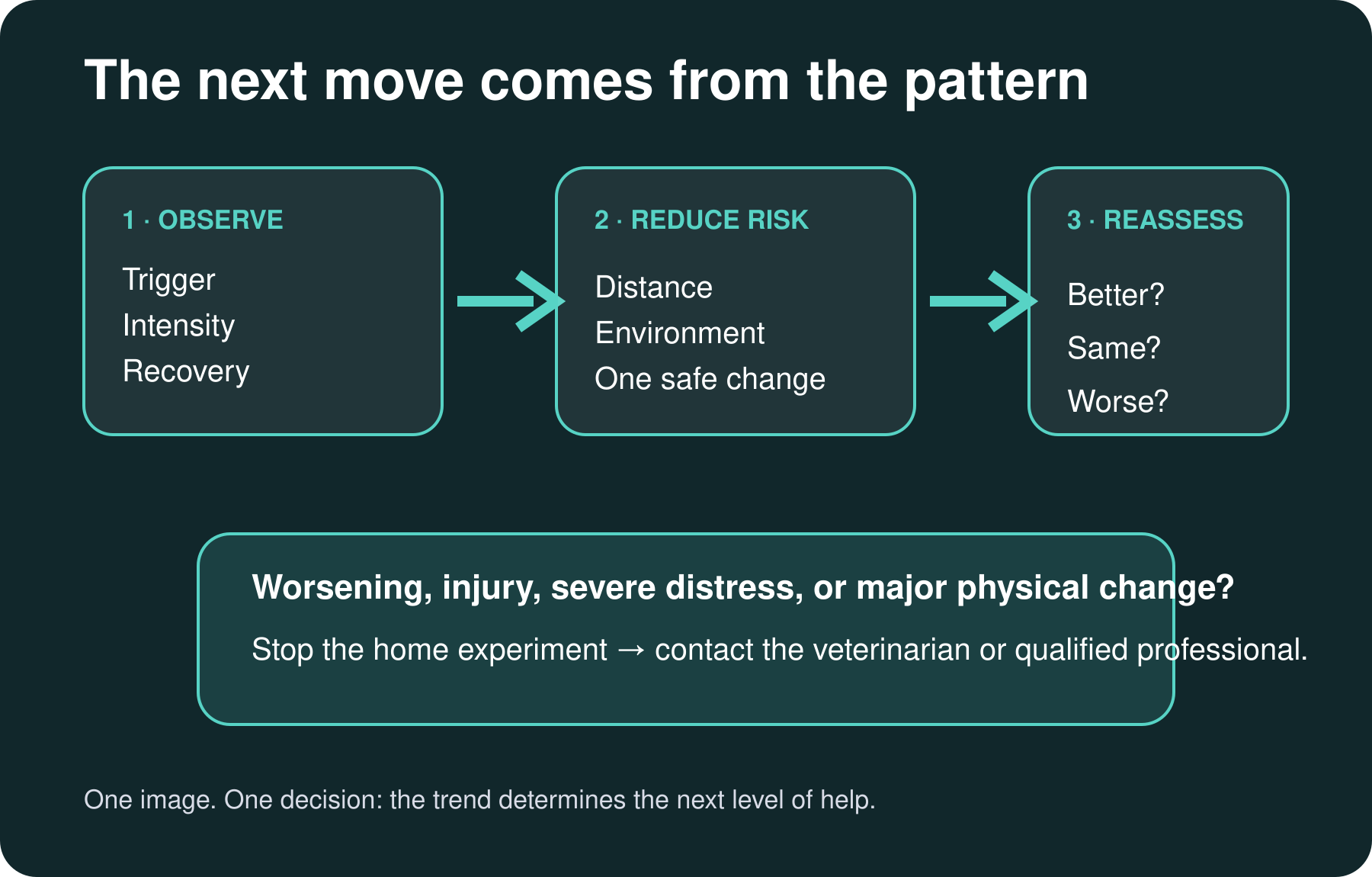
For dog gets overstimulated playing fetch, the sequence below keeps action attached to evidence instead of a guess. Its fixed point is simple: More repetitions can build more arousal. The missing skill may be recovery, not endurance.
- Look at the whole sequence: identify the first point where control changes. Reassess by watching barking before the throw, collisions, hard grabbing, refusal to release, and inability to stop.
- Use recovery as the main metric: insert short pauses before the dog loses responsiveness. Reassess by watching breathing, body tension, response to a familiar cue, and time to relax.
- Reduce predictable physical risk: use safer footing, lower trajectories, fewer repetitions, and warm-up movement. Reassess by watching surface, throw direction, collisions, limping, and next-day stiffness.
- Teach the end away from peak arousal: end early and transition to a lower-intensity activity. Reassess by watching whether the dog can release, take a drink, sniff, and move away from the launch point.
- Avoid using fetch as the only outlet: balance fetch with sniffing and calmer problem-solving. Reassess by watching daily mix of exploration, chewing, social play, training, rest, and aerobic movement.
- Check heat and breathing: stop early, provide water and shade, and avoid hot conditions. Reassess by watching temperature, humidity, shade, panting quality, coordination, gum color, and recovery.
If these steps cannot be carried out without triggering barking before the throw, collisions, hard grabbing, refusal to release, and inability to stop, stop increasing the challenge. That result is enough to justify a safer setup and a case-specific conversation; the dog does not need to fail more dramatically first.
Quick decision questions
Which change matters first?
For dog gets overstimulated playing fetch, begin with this observable distinction: breathing, body tension, response to a familiar cue, and time to relax. The first low-risk response is to insert short pauses before the dog loses responsiveness. If that cannot be done without provoking the problem, move the case out of trial-and-error mode.
What belongs in the record?
Track daily mix of exploration, chewing, social play, training, rest, and aerobic movement. Add the time needed to recover and any change in appetite, sleep, movement, elimination, or social behavior. Record naturally occurring events; do not stage a stronger version for the camera.
When does outside help move forward?
Age is only one part of capacity. A useful handoff includes what triggered the event, what reduced it, and what happened after ask for an individualized exercise plan when health risk exists.
What to bring to the next conversation
Bring a concise record tied to this article’s question: dog gets overstimulated playing fetch. Include when the pattern began, the first observable change, the most difficult context, what reliably reduces intensity, how long recovery takes, and whether appetite, sleep, movement, elimination, breathing, or social behavior changed at the same time.
For “When Fetch Winds a Dog Up Instead of Wearing Them Out,” list each management step already tried and what followed. That prevents a veterinary or behavior visit from beginning with vague descriptions such as “better” or “worse.” It also shows whether improvement followed the planned change or merely coincided with the trigger disappearing.
Keep the main conclusion visible while you collect details: More repetitions can build more arousal. The missing skill may be recovery, not endurance. New information should refine that decision, not erase safety boundaries. If a recommendation depends on diagnosis, exercise capacity, calorie target, medication, or a controlled behavior setup, leave it with the professional who can examine the dog and review the history.
The AAHA Mature Adult Dog Guidance source supports this decision framework, but guidance for a population cannot predict one dog’s outcome. Claim strength must remain unchanged after SEO, visual design, and editing. For dog gets overstimulated playing fetch, the aim is a defensible next move—not a confident-sounding diagnosis.
Do not delay that conversation merely to complete a perfect record of quality of movement and recovery across the session. Worsening signs, injury, severe distress, or loss of normal function deserves timely care with the information already available.
Sources
How this article is checked. Every claim in this article goes through a structured evidence review before publishing: checked against veterinary guidelines (AAHA, WSAVA, AVMA) and peer-reviewed veterinary research, graded for how strong the evidence actually is, and screened for overstated or missing context. Articles that don't clear this review are not published. This is general educational information, not a substitute for professional veterinary advice — always consult your vet about your individual dog.