Leash Reactivity: Use Distance Before You Ask for Better Behavior
Most owners do not need a longer list of possibilities. They need to know which detail changes the next move. The usable training zone is the distance where your dog can notice the trigger and still think. This guide turns that distinction into an observation plan: what to notice, what you can change safely, and when the pattern belongs with your veterinarian or a qualified behavior professional.
Reactivity is a description, not a diagnosis
Barking, lunging, spinning, or pulling on leash describes what happens; it does not tell you whether the driver is fear, frustration, excitement, pain, or learned anticipation. The distinction becomes clearer when you track trigger type, starting distance, body tension, recovery time, and whether the response also occurs off leash. This is especially useful when several people handle the dog and remember the event differently.
Practical decision: treat the pattern as information and avoid labeling the dog aggressive from one display. Change only what the dog can tolerate without force. A remote article cannot determine bite risk or motivation. If the household cannot maintain that boundary consistently, professional help becomes part of risk management rather than a last resort.
Find the thinking distance
Learning is hard once the dog is already exploding. The practical threshold is where the dog notices the trigger but can still orient back, eat, and move with you. Before adding a product or a harder exercise, look at mouth closing, weight shifting forward, fixed staring, slowed responses, or refusal of food. These signs tell you whether the present setup is workable.
cross the street, turn around, step behind a visual barrier, or increase distance early. Recheck the same markers afterward instead of relying on whether the dog simply became quieter. Food refusal can reflect stress, but also appetite and environment; read the whole dog. Quiet behavior can reflect comfort, fatigue, freezing, or learned inhibition; the surrounding pattern decides which explanation is plausible.
Stop rehearsing the full reaction
Every walk does not need to be a training session. Repeated close encounters can keep arousal high and make careful practice difficult. The details worth capturing are routes, corners, elevators, narrow sidewalks, and times that reliably remove escape options. Those observations describe a sequence rather than forcing one moment into a diagnosis. Note what changed first and how long the dog needed to return to baseline.
Start here: choose quieter times and wider routes while skills develop. Keep the setup easy enough that safety and choice remain intact. Avoiding some triggers temporarily is management, not permanent isolation. If the response worsens after the change, undo the added difficulty and reassess the premise.
Build a simple exit cue
An exit cue should move the team away before the leash tightens and before the handler panics. Watch for whether the dog follows a cheerful turn in a quiet setting. The earliest change is usually more actionable than the loudest part of the event, because it shows where prevention was still possible.
practice a U-turn and hand target without triggers, then use it early outside. Then compare intensity, duration, and recovery with the previous occurrence. Do not drag the dog toward or away from a trigger by the neck. A plan earns another attempt only when the dog remains physically safe and the trend is stable or improving.
Pair triggers with safety at a workable distance
When the dog sees a trigger below threshold, food or another valued outcome can change the prediction attached to that sight. For an owner, the usable evidence is concrete: soft body, brief glance, voluntary check-in, and faster recovery over sessions. Write those details down without deliberately recreating the problem. A natural event observed safely is enough.
The next move: deliver reinforcement after noticing the trigger and leave while the dog is still successful. This is a management or learning step, not proof of a diagnosis. Getting closer is not the only measure of progress. Calm recovery matters. When a physical sign appears alongside the pattern, the medical question moves ahead of further practice.
Equipment should reduce risk, not pain
A secure harness and backup connection can prevent escape. Equipment cannot replace distance or change emotion by itself. Do not judge it from one dramatic snapshot. Instead, compare fit, chafing, backing out, leash handling, and whether the tool increases distress. Context can change the meaning of the same outward behavior.
A reasonable first response is to use well-fitted, non-aversive equipment and rehearse handling indoors. Give that change a fair but safe trial, and stop before distress or injury becomes the price of information. Tools that rely on pain, choking, or startling can worsen fear and create unsafe associations. Improvement should look like easier recovery, not mere suppression.
Rule out pain when the pattern changes
A dog who suddenly reacts to approaches, handling, or other dogs may be protecting a painful body. The distinction becomes clearer when you track new sensitivity, reluctance to move, altered gait, sleep change, or a lower threshold than usual. This is especially useful when several people handle the dog and remember the event differently.
Practical decision: book a veterinary exam for sudden or marked behavior change. Change only what the dog can tolerate without force. Behavior and medical causes can coexist. If the household cannot maintain that boundary consistently, professional help becomes part of risk management rather than a last resort.
Escalate professional support by risk
Close-range reactions, redirection onto the handler, bite history, or an environment with unavoidable encounters calls for individualized help. Before adding a product or a harder exercise, look at contact, punctures, inability to recover, and household ability to maintain distance. These signs tell you whether the present setup is workable.
start with the veterinarian and a qualified reward-based behavior professional. Recheck the same markers afterward instead of relying on whether the dog simply became quieter. Do not use public group classes as the first test for a dog who cannot stay safely below threshold. Quiet behavior can reflect comfort, fatigue, freezing, or learned inhibition; the surrounding pattern decides which explanation is plausible.
Measure recovery, not obedience theater
A useful log shows whether the dog can recover and make choices, not whether the handler forced a perfect heel. The details worth capturing are distance, intensity, duration, recovery, and successful exits. Those observations describe a sequence rather than forcing one moment into a diagnosis. Note what changed first and how long the dog needed to return to baseline.
Start here: review trends weekly and adjust routes before raising difficulty. Keep the setup easy enough that safety and choice remain intact. Progress is rarely linear; one hard walk does not erase learning. If the response worsens after the change, undo the added difficulty and reassess the premise.
Your decision map
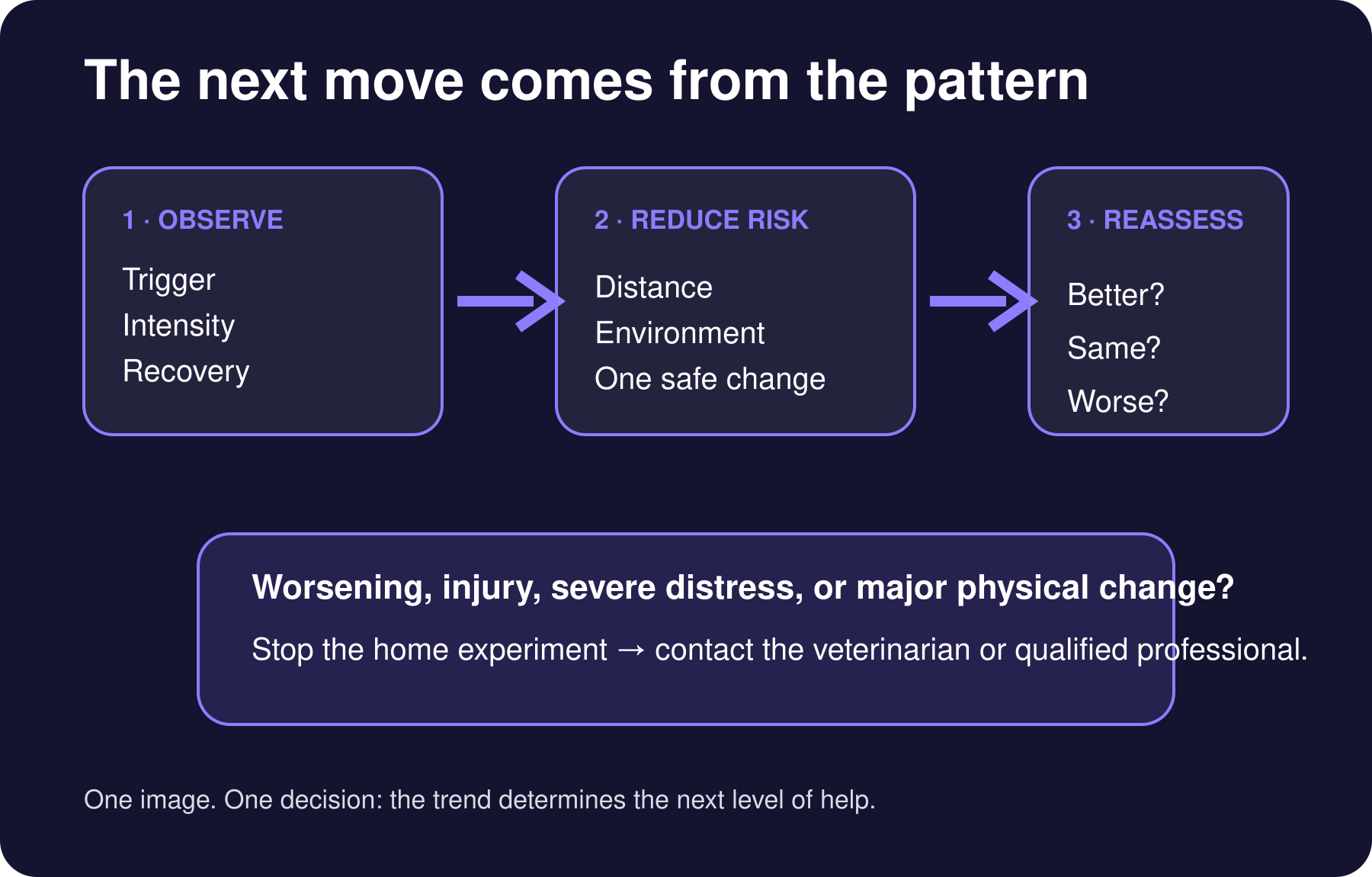
For dog leash reactivity what to do, the sequence below keeps action attached to evidence instead of a guess. Its fixed point is simple: The usable training zone is the distance where your dog can notice the trigger and still think.
- Reactivity is a description, not a diagnosis: treat the pattern as information and avoid labeling the dog aggressive from one display. Reassess by watching trigger type, starting distance, body tension, recovery time, and whether the response also occurs off leash.
- Find the thinking distance: cross the street, turn around, step behind a visual barrier, or increase distance early. Reassess by watching mouth closing, weight shifting forward, fixed staring, slowed responses, or refusal of food.
- Stop rehearsing the full reaction: choose quieter times and wider routes while skills develop. Reassess by watching routes, corners, elevators, narrow sidewalks, and times that reliably remove escape options.
- Build a simple exit cue: practice a U-turn and hand target without triggers, then use it early outside. Reassess by watching whether the dog follows a cheerful turn in a quiet setting.
- Pair triggers with safety at a workable distance: deliver reinforcement after noticing the trigger and leave while the dog is still successful. Reassess by watching soft body, brief glance, voluntary check-in, and faster recovery over sessions.
- Equipment should reduce risk, not pain: use well-fitted, non-aversive equipment and rehearse handling indoors. Reassess by watching fit, chafing, backing out, leash handling, and whether the tool increases distress.
If these steps cannot be carried out without triggering trigger type, starting distance, body tension, recovery time, and whether the response also occurs off leash, stop increasing the challenge. That result is enough to justify a safer setup and a case-specific conversation; the dog does not need to fail more dramatically first.
Quick decision questions
Which change matters first?
For dog leash reactivity what to do, begin with this observable distinction: mouth closing, weight shifting forward, fixed staring, slowed responses, or refusal of food. The first low-risk response is to cross the street, turn around, step behind a visual barrier, or increase distance early. If that cannot be done without provoking the problem, move the case out of trial-and-error mode.
What belongs in the record?
Track soft body, brief glance, voluntary check-in, and faster recovery over sessions. Add the time needed to recover and any change in appetite, sleep, movement, elimination, or social behavior. Record naturally occurring events; do not stage a stronger version for the camera.
When does outside help move forward?
Do not use public group classes as the first test for a dog who cannot stay safely below threshold. A useful handoff includes what triggered the event, what reduced it, and what happened after start with the veterinarian and a qualified reward-based behavior professional.
Sources
How this article is checked. Every claim in this article goes through a structured evidence review before publishing: checked against veterinary guidelines (AAHA, WSAVA, AVMA) and peer-reviewed veterinary research, graded for how strong the evidence actually is, and screened for overstated or missing context. Articles that don't clear this review are not published. This is general educational information, not a substitute for professional veterinary advice — always consult your vet about your individual dog.