
He’s Just Getting Old: The Senior-Dog Signs You Shouldn’t Ignore
Your old dog sleeps more. Gets grumpy. Has the odd accident indoors. Paces at night. And every time, you tell yourself the same gentle thing: he’s just getting old.
Sometimes that’s true. But “just old” is also the most dangerous phrase in senior dog care — because
it’s the blanket we throw over symptoms that were treatable, right up until we stopped
looking.
Aging isn’t a diagnosis. It’s the thing that hides the diagnosis.
The Problem With “Just Old”
Here’s what research keeps finding: many signs owners write off as normal aging are actually early
markers of conditions vets can help with. Grumpiness can be arthritis pain. Night pacing and
confusion can be cognitive decline — a real, manageable condition, not an inevitability. House
accidents can be a urinary infection, kidney issue, or something else entirely fixable.
The tragedy isn’t that dogs get old. It’s that a treatable problem gets filed under “old age” and
never gets treated.
The Checklist Vets Use: DISHAA
There’s a reason vets have a formal checklist for this. Owners miss it otherwise.
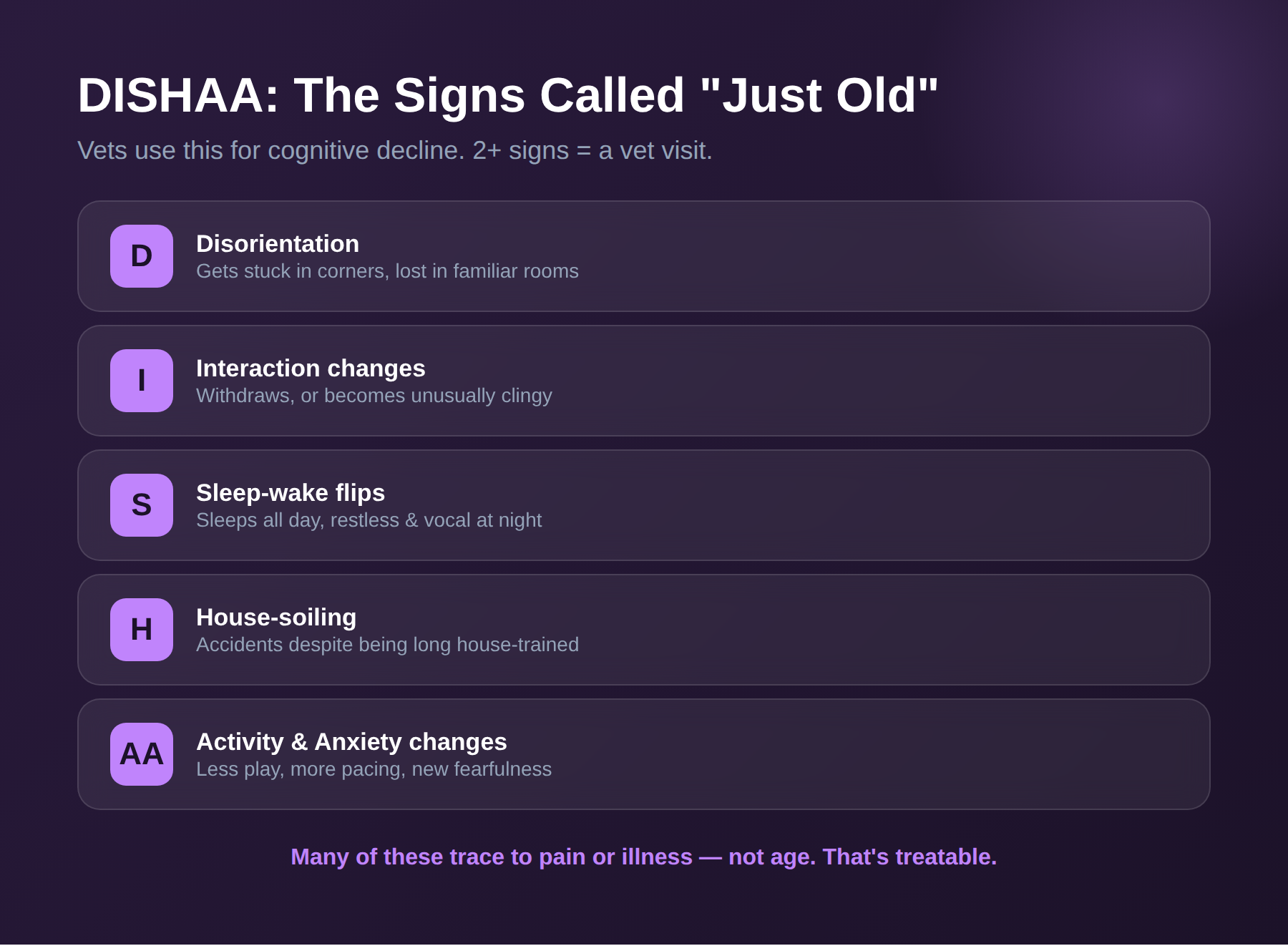
Vets use the acronym DISHAA to catch canine cognitive decline early: Disorientation,
Interaction changes, Sleep-wake reversals, House-soiling, and
Activity/Anxiety changes. It’s common — well over half of dogs past 15
show cognitive signs — but heavily underdiagnosed, precisely because the symptoms look like
“getting old.” Experts suggest screening from age 7.
Here’s the part that changes everything: a 2023 study published in the journal Animals
found that dogs with more cognitive-decline signs also had more signs of pain and physical
illness (especially musculoskeletal and neurological signs). In other words, what looks like
a “senior moment” is often the body hurting somewhere — arthritis, dental pain, a metabolic
problem. The confusion isn’t always the brain aging. Sometimes it’s untreated pain wearing an
old-dog mask.
Which is why “he’s just old” is such a costly assumption. Behind it can sit a dog in discomfort that
a vet could actually relieve.
What to Do Instead
🐾 A smarter senior-dog approach
- Run the DISHAA list honestly. Two or more signs — disorientation, withdrawal, night restlessness, new accidents — earns a vet visit, not a shrug.
- Treat behavior changes as medical until proven otherwise. Sudden grumpiness usually means pain. New night-waking can mean discomfort or cognitive change — both manageable.
- Start senior wellness screening around 7. Bloodwork and exams catch kidney, liver, and thyroid issues while they’re still easy to manage.
- Support the aging brain. Routine, enrichment, and vet-guided diet or supplements can genuinely slow cognitive decline — it’s managed, not just endured.
The honest line: not every change is an emergency, and old dogs genuinely do slow down
and sleep more — that part is normal. But new confusion, sudden irritability, weight
loss, increased thirst, or house-soiling in a trained dog are worth a vet’s eyes. You’re not being
paranoid; you’re catching things early, which is the whole game with senior dogs.
The Bottom Line
- “Just getting old” often hides treatable conditions — pain, cognitive decline, organ issues.
- Use the DISHAA checklist; two or more signs means a vet visit, not a shrug.
- What looks like a “senior moment” is often untreated pain or illness, per recent research.
- Screen from around age 7 — early catches are the whole advantage in senior care.
“He’s just old” is a guess.
A vet visit is an answer.
Here to help you care smarter — not spend more. 🐾
What to Bring to the Appointment
A DISHAA count of two or more earns a visit — but a more specific record makes that visit far more useful than “he’s been acting different.”
Practical signs of arthritis pain owners often miss
Dogs are stoic about joint pain, so the tells are often behavioral rather than an obvious limp:
- Slower to rise after resting, or hesitating before jumping onto furniture or into the car
- A shortened, more careful stride rather than dramatic lameness
- Increased irritability specifically when touched, picked up, or approached while resting
- Reluctance on stairs, especially going down, which loads joints more than going up
- Licking or chewing at a specific joint
None of these alone confirms arthritis, but a cluster of them — especially combined with the behavior changes DISHAA screens for — strengthens the case that “grumpiness” and “slowing down” share a physical root rather than being purely age-related personality drift.
A short pre-visit checklist
- Timeline: When did each change start? Gradual over months, or a clear before/after point?
- Pattern: Worse at a specific time of day, after specific activity, or consistently present?
- Diet and water: Any recent change in appetite, thirst, or weight — even subtle?
- Mobility specifics: Which activities have visibly gotten harder — stairs, jumping, long walks, standing from lying down?
- Current medications and supplements: A complete list, including over-the-counter joint or calming products.
This kind of record does the same job for a senior dog that a symptom diary does for any chronic condition: it turns “he seems different lately” into a timeline a veterinarian can actually work with, rather than asking them to reconstruct months of gradual change from a single ten-minute exam.
Supporting the aging brain day to day
Beyond the vet visit, a handful of routine changes have real support for slowing cognitive decline rather than just managing symptoms after the fact. Keeping a consistent daily routine reduces the disorientation that comes with an already-changing brain trying to track an also-changing schedule. Continued mental stimulation — short training refreshers, food puzzles, new-but-manageable walking routes — appears to help maintain cognitive function longer than a completely unstimulating routine, similar to the “use it or lose it” pattern seen in aging research more broadly. Physical exercise matched to what the dog’s joints can currently handle also supports both mobility and mood; the goal is consistent, gentle activity rather than pushing through discomfort.
What a vet visit for cognitive signs typically involves
There’s no single blood test that diagnoses cognitive dysfunction — diagnosis is largely based on ruling out other medical causes (thyroid disease, vision or hearing loss, pain, other organ dysfunction) that can produce similar-looking confusion or behavior change, then matching the remaining pattern against the DISHAA criteria. That’s exactly why the screening bloodwork mentioned above matters: it’s not a delay tactic, it’s how a vet separates “aging brain” from “something else that looks like aging brain” — several of which are far more directly treatable than cognitive decline itself.
Building a simple home tracking habit
A one-line note a few times a week — sleep pattern, appetite, any confusion, any new stiffness — turns vague impressions into a pattern a vet can actually use, the same principle behind tracking water intake or bathroom habits for other symptoms. This doesn’t need to be elaborate: a phone note or a page in a notebook works fine. The value isn’t in the format, it’s in having several weeks of specific observations instead of a single “he seems different” impression when the appointment finally happens. Many owners find that once they start tracking, they notice the pattern was more consistent — or more recent — than they’d assumed from memory alone.
Talking to other household members about the changes
Cognitive and mobility changes in a senior dog are easier to manage when everyone in the household is watching for the same signs and using the same approach — inconsistent handling (one person scolding house-soiling, another quietly cleaning it up without mentioning it) can actually slow down both diagnosis and adaptation. A short conversation about what DISHAA covers and what the household has agreed to watch for turns an individual observation into a shared, more reliable picture for the eventual vet visit.
Patience as part of the plan
Senior dogs navigating cognitive or physical decline often do better with more predictable routines and gentler corrections than a younger dog might need — not because they’re being difficult, but because the confusion or discomfort itself is the underlying driver of many of the behaviors that frustrate owners. Approaching this stage with patience isn’t just kindness; it measurably reduces the anxiety that can otherwise worsen the very symptoms DISHAA is trying to catch.
Many veterinary clinics now offer dedicated senior wellness visits structured specifically around this kind of screening, rather than folding it into a standard annual exam — worth asking about by name when scheduling, since the visit format itself can shape how thoroughly these subtler signs get discussed. None of this replaces a veterinarian’s judgment, but it gives that judgment better material to work with, which is really the whole point of paying close attention in the first place. That shift in framing — from managing an old dog to actively treating a treatable condition — is often the most useful thing a diagnosis provides.
For general information only; not a substitute for veterinary care. New confusion, sudden
irritability, weight loss, increased thirst, or house-soiling in a house-trained dog warrant a
veterinary exam. Background drawn from veterinary references including PetMD, VCA Animal Hospitals,
Vetster, and peer-reviewed research on canine cognitive dysfunction.
How this article is checked. Every claim in this article goes through a structured evidence review before publishing: checked against veterinary guidelines (AAHA, WSAVA, AVMA) and peer-reviewed veterinary research, graded for how strong the evidence actually is, and screened for overstated or missing context. Articles that don't clear this review are not published. This is general educational information, not a substitute for professional veterinary advice — always consult your vet about your individual dog.
3 Comments
Comments are closed.