
Why Your Dog Won’t Stop Licking Their Paws (It’s Not a Habit)
You’ve probably said it out loud: “He just does that. It’s a nervous habit.” So you ignore it, or gently tell him to stop. Meanwhile the real cause keeps working.
Here’s what vets see constantly: chronic paw-licking is rarely behavioral. Far more often
it’s the visible tip of something itchy underneath — and by calling it a “habit,” owners accidentally
delay the one thing that would actually help.
Constant paw-licking isn’t a personality quirk. It’s usually an allergy, made visible.
What the Licking Is Really Doing
Allergies are the single most common driver of chronic paw-licking in dogs — environmental ones
(pollen, grass, dust mites) and food ones alike. The allergy makes the skin itch; the paws are
itchy; the dog licks. Simple. But then it turns into a trap:
Damp skin grows yeast. Yeast itches more.
So the dog licks more, which keeps the skin wet, which feeds more yeast — a self-feeding
cycle. That “corn-chip” or musty smell from the paws? That’s the yeast. The lick you dismissed
as a habit has become an infection.
The Clue Almost Nobody Uses: Where They Lick
The location of the licking is the most useful thing you can tell your vet.
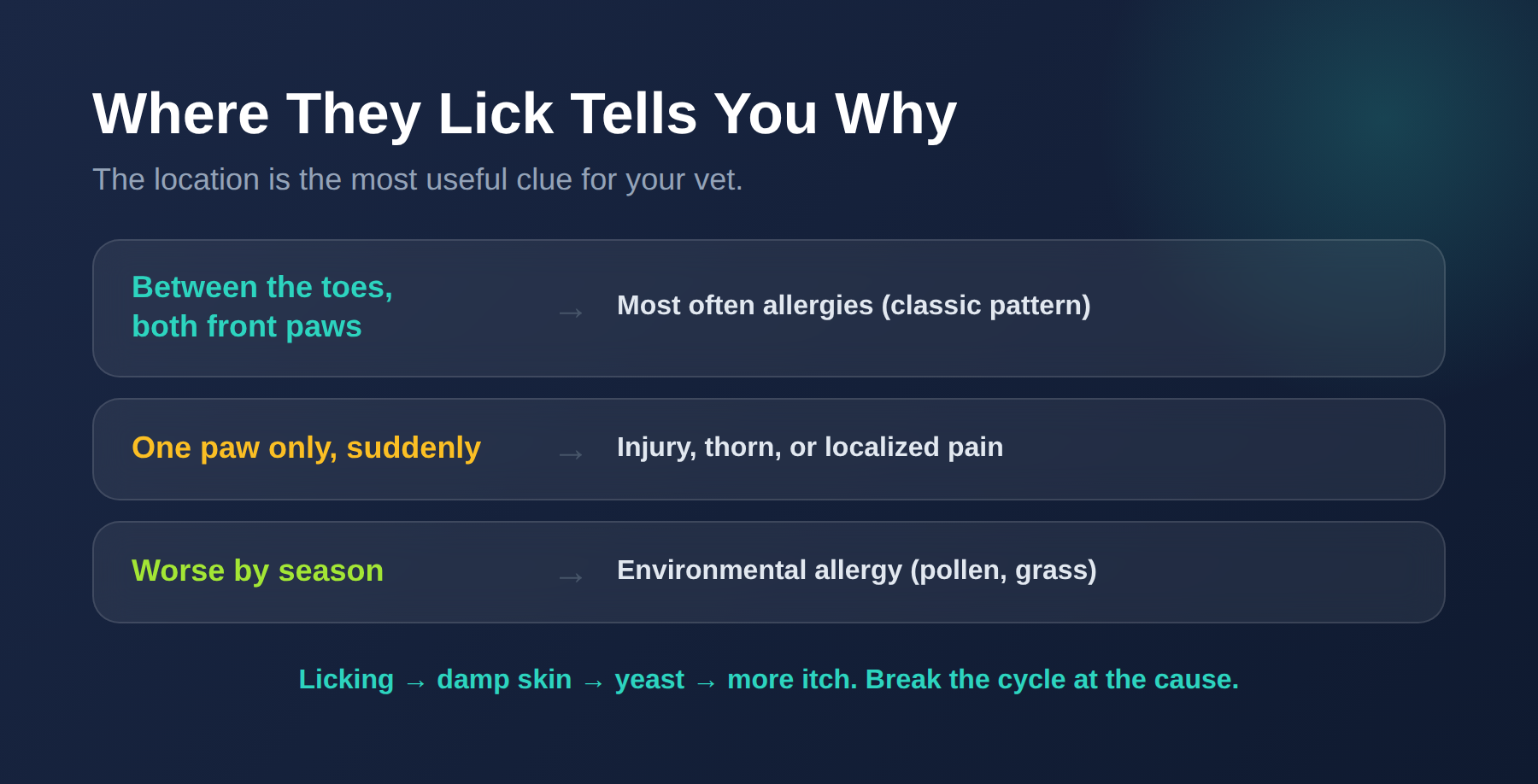
Licking between the toes on both front paws points most often to allergies — that thin
skin meets the ground with every step. Suddenly fixated on one paw? That’s more likely
an injury, a thorn, a burr, or localized pain. Worse in certain seasons? That points to
an environmental allergy. Breed matters too — a 2025 study of small and medium breeds in Korea
(published in Veterinary Dermatology) found the paws were affected in 73% of French
Bulldogs with allergic skin disease — a small group within the study, but a striking pattern
worth knowing if you own one.
This is the same lesson as the tear stains and the bad breath: the spot you’re looking at is where
the signal shows up, not where the problem lives. The paw is itchy because of something bigger —
an allergy, a diet trigger, the skin barrier breaking down. Treat the lick and you treat nothing.
Treat the cause and the lick fades on its own.
What Actually Helps
🐾 Breaking the paw-licking cycle
- Wipe the paws after every walk. The simplest habit there is — it clears pollen and lawn chemicals before they trigger a flare. Dry between the toes.
- Note the pattern for your vet: which paws, how often, whether it interrupts play, whether it’s seasonal. This shortcuts the diagnosis.
- Suspected mild yeast on intact skin? A short paw soak can ease irritation — but it won’t cure an infection or the allergy beneath it.
- Ask about the diet. If it’s a food allergy, your vet may suggest a novel-protein or hydrolyzed diet to find the trigger.
The honest line: if the skin is red, swollen, smelly, raw, or the licking is constant,
that’s not a home-remedy situation — it’s a vet visit. Secondary infections need real treatment, and
the underlying allergy usually needs a proper diagnosis. Anxiety can cause licking, but it’s
uncommon — assume medical first, so you don’t miss it.
The Bottom Line
- Chronic paw-licking is usually allergies, not a nervous habit.
- Licking damages the skin barrier — damp fur grows yeast, which itches more, feeding a cycle.
- Where your dog licks (both front paws vs. one; seasonal vs. constant) is the best clue for your vet.
- Wipe paws after walks, note the pattern, and see a vet for red, smelly, or raw skin.
It was never a habit.
It was a signal you were meant to read.
Here to help you care smarter — not spend more. 🐾
The Itch-Lick Cycle — and What Location Tells Your Vet
Chronic licking isn’t just a symptom of irritation — it becomes its own cause. Saliva contact keeps skin moist, moisture supports yeast and bacterial overgrowth, and that overgrowth itches, which triggers more licking. This is why a “small” habit so often becomes a persistent, hard-to-break pattern: the behavior itself is actively maintaining the problem it started as a response to.
Which paw, and where on the paw, is diagnostic information
- All four paws, symmetrically: more suggestive of a systemic cause — environmental or food allergy, or a whole-body skin condition.
- One paw only, persistently: more suggestive of a localized cause — a foreign body (grass awn, splinter), an injury, or a focal infection.
- Between the toes specifically: classic location for yeast (Malassezia) overgrowth and contact allergens like lawn chemicals or de-icing salt.
- Licking that worsens after specific exposures (a certain food, a certain walk route, a certain season): points toward an identifiable trigger worth tracking rather than guessing at.
Signs the cycle has moved past “just licking”
Reddish-brown staining on light-colored fur, a moist or matted texture between toes, a yeasty or “corn chip” smell, or visible swelling are signs of secondary infection layered on top of the original itch. At that point, addressing only the underlying allergy without also treating the active infection typically won’t stop the licking — both need attention, and a vet visit becomes the more efficient path rather than an admission that home management failed.
Breed and coat factors worth knowing
Dogs with known allergy predispositions (many terrier breeds, retrievers, bulldogs, and other brachycephalic breeds) and dogs with dense, moisture-trapping paw fur are statistically more likely to develop this pattern — not because of “nervous habits,” but because their anatomy and immune tendencies create more opportunities for the itch-lick cycle to start in the first place.
What’s reasonable to try at home — and what to skip
Rinsing and thoroughly drying paws after walks, especially after exposure to wet grass, de-icing chemicals, or standing water, is a low-risk habit that reduces one common trigger without needing a diagnosis first. A short course of a vet-recommended topical antifungal or antibacterial wipe can help once yeast or bacterial overgrowth is confirmed or strongly suspected, but reaching for a leftover human antifungal cream or a friend’s leftover prescription is a genuinely bad idea — wrong strength, wrong organism target, and potential for the dog to lick off and ingest something not meant to be swallowed. Bitter-tasting anti-lick sprays can interrupt the behavior temporarily but don’t address why the licking started, and relying on them alone typically just delays the vet visit that was needed anyway.
When an elimination diet enters the picture
If seasonal or environmental triggers have been reasonably ruled out and the licking persists year-round, food allergy becomes a more likely contributor — and the only reliable way to confirm it is a proper elimination diet trial using a novel or hydrolyzed protein source for a sustained period, under veterinary guidance, not a quick switch to a different bag of food for a week. This is a slower process than owners often expect, which is exactly why it’s usually pursued after simpler explanations have already been addressed rather than as the first step.
Environmental allergens versus food allergens — a rough way to tell them apart
Environmental allergies (pollen, dust mites, mold) often show a seasonal pattern — worse in spring or fall, better in winter — and frequently affect the paws alongside the face, ears, and armpits. Food allergies tend to be less seasonal and more constant year-round, though the two can absolutely coexist in the same dog, which is part of why diagnosis isn’t always straightforward. Neither pattern is a substitute for an actual veterinary allergy workup, but noticing whether the licking tracks with the calendar or stays flat across seasons is a genuinely useful clue to bring to that appointment.
A quick note on stress-related licking
True behavioral licking exists, but it’s far less common than owners often assume, and it’s a diagnosis reached by ruling out medical causes first — not a default explanation reached for because nothing obvious was found on a quick look. A dog genuinely licking from stress or boredom alone, with no underlying skin issue, usually shows other stress signals too (pacing, changes in appetite, other repetitive behaviors), and even then, addressing the underlying stressor works better than treating the licking symptom in isolation.
Keeping a simple log of when licking flares up alongside potential triggers — a new treat, a walk through a particular park, a change in laundry detergent for bedding — can surface a pattern faster than memory alone, the same tracking principle that helps with most chronic, intermittent symptoms. Bringing that log to the veterinary visit, alongside a description of exactly which paw and which part of the paw is affected, tends to shorten the diagnostic process meaningfully compared to a general description alone. A little patience with the process usually pays off faster than owners expect once the actual cause is identified.
For general information only; not a substitute for veterinary care. Red, swollen, smelly, or raw
paws, or constant licking, warrant a veterinary exam. Background drawn from veterinary and
pet-health references including PetMD, Chewy veterinary guidance, Vetster, and a 2025 breed study on
canine allergic skin disease.
How this article is checked. Every claim in this article goes through a structured evidence review before publishing: checked against veterinary guidelines (AAHA, WSAVA, AVMA) and peer-reviewed veterinary research, graded for how strong the evidence actually is, and screened for overstated or missing context. Articles that don't clear this review are not published. This is general educational information, not a substitute for professional veterinary advice — always consult your vet about your individual dog.
One Comment
Comments are closed.