
Dog Probiotics Aren’t a Cure-All — Match the Strain to the Goal
“Just fix the gut.” You’ve heard it for tear stains, for bad breath, for itchy paws. So you reach for a probiotic. Reasonable — but here’s the part the label won’t tell you.
A probiotic is not a gut reset button. It’s a specific tool with a specific job, and the honest answer to “do they work?” is neither the hype (“yes, for everything!”) nor the cynicism (“total scam”). It’s narrower — and once you know the line, you stop wasting money.
The question isn’t “does it work.” It’s “work at what.”
First, What a Probiotic Actually Is
Probiotics are live beneficial bacteria. Given in the right amount, they tip a dog’s gut ecosystem back toward the helpful species — crowding out troublemakers, lowering gut pH so pathogens struggle, and helping keep the intestinal lining healthy. When that internal balance is off — a state vets call dysbiosis — you can see loose stools, gas, low energy, even itchy skin. Probiotics nudge the balance back.
That’s real. What’s not real is the idea that a daily scoop fixes anything and everything.
Where the Evidence Is Strong — and Where It Thins Out
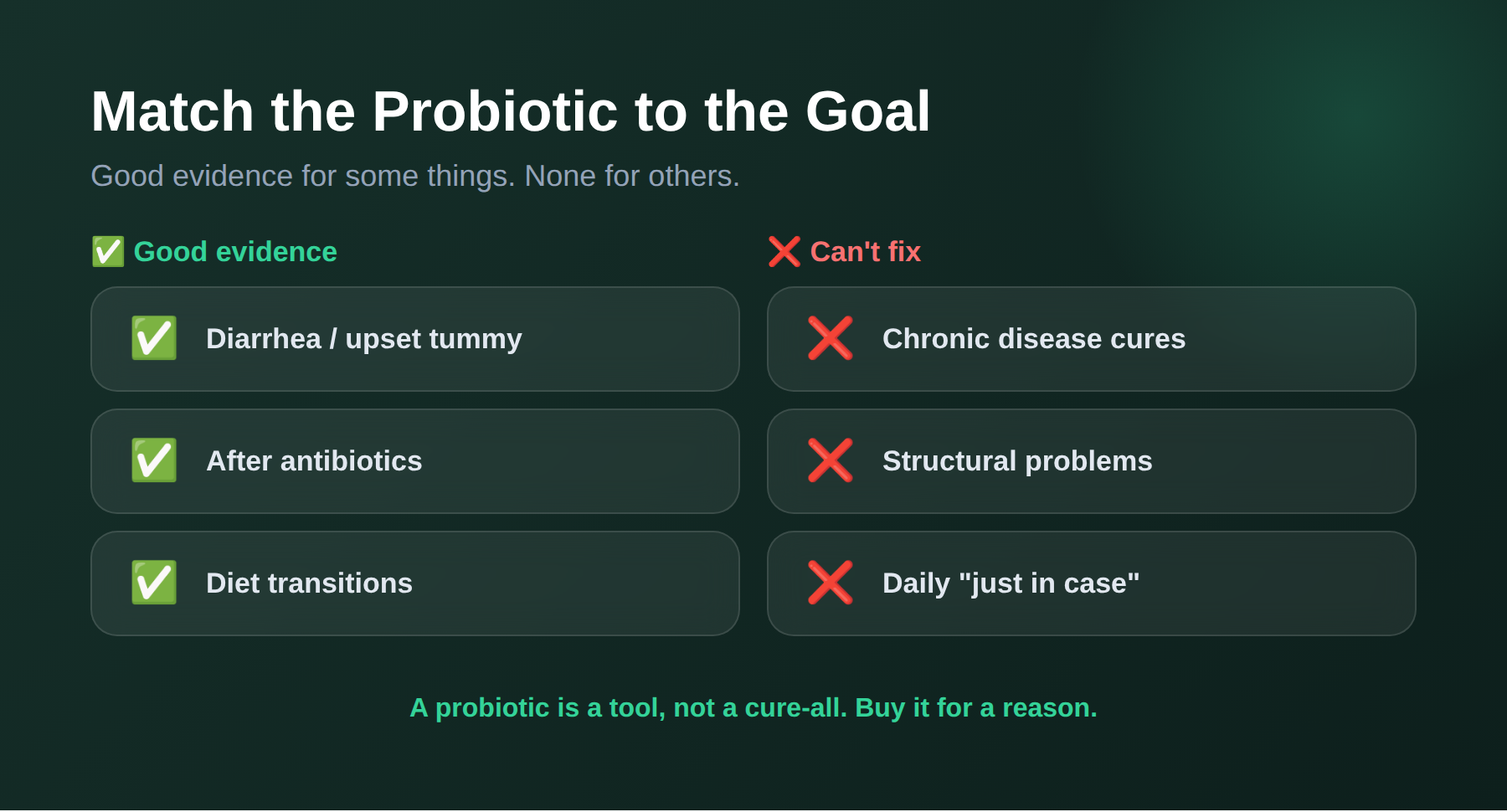
The strongest, most repeatable evidence is for short-term digestive trouble: controlled trials show probiotics can meaningfully shorten a bout of diarrhea and help the gut rebound after a course of antibiotics, a diet change, or a stressful upheaval. Veterinary researchers, including teams studying canine gut health, back this specific use.
The wider claims — glossy coat, better mood, calmer behavior — are biologically plausible and genuinely interesting in early research, but the evidence is still thin. That doesn’t make them false. It makes them not yet proven — which is a very different thing from what the packaging implies.
A probiotic bought on a vibe usually doesn’t.
“My dog had diarrhea after antibiotics” is a goal. “I want to fix the gut” is a wish. The first has evidence behind it. The second is where money quietly disappears.
So Does That Mean the Gut Doesn’t Matter?
Just the opposite. And this is where the last few pieces connect.
We’ve now landed on the gut three times — tear stains, bad breath, and here. That’s likely not a coincidence, and it’s not a sales pitch. The gut has a well-documented influence on inflammation across the body, which is one reason an imbalance can show up in places that seem unrelated: the skin, and possibly the eyes and mouth. How far that connection reaches for any single symptom is still being worked out.
But “the gut matters” and “so buy a probiotic” are two different sentences. The gut is the territory. A probiotic is just one tool for it — often less powerful than the boring one nobody’s selling: a cleaner, simpler diet.
How to Actually Decide
🐾 Is a probiotic worth it for your dog?
- Yes, likely: recovering from diarrhea, a recent antibiotic course, a diet switch, or a stressful change with digestive fallout.
- Maybe, with a plan: ongoing mild digestive wobble — but pair it with fixing the diet, not instead of it.
- Probably not: a healthy dog, no symptoms, “just in case.” There’s no strong evidence this does anything.
- On the label, look for: named strains, a CFU count guaranteed through expiration (not just at packaging), and a formula made for dogs.
The honest line: probiotics are supportive care, not a cure. If your dog has persistent diarrhea, weight loss, vomiting, or symptoms that don’t resolve, that’s a vet visit — a supplement can’t clear a parasite, fix a structural problem, or treat serious disease.
The Bottom Line
- Probiotics have solid evidence for short-term digestive upset and post-antibiotic recovery.
- The broader “fixes everything” claims aren’t proven — plausible, but not yet backed.
- The gut really does matter (tear stains, breath, skin all trace back to it) — but diet is often the bigger lever than any supplement.
- Buy a probiotic for a specific goal, check the label, and see a vet for anything persistent.
Don’t buy the promise.
Buy the specific job.
Here to help you care smarter — not spend more. 🐾
The Short List of Strains With Actual Approval
“Match the strain to the goal” only works if you know which strains have real evidence behind them for dogs specifically — not repurposed from a human-probiotic aisle.
The European Food Safety Authority has formally reviewed probiotic strains for safety and efficacy as feed additives in dogs. As of the most recent reviews, only a small handful have cleared that bar for canine use:
- Enterococcus faecium (specific approved sub-strains, including the one marketed as SF68) — the most-studied strain for acute and stress-related diarrhea in dogs, typically dosed around 1–2 × 10⁹ CFU per day.
- Bacillus subtilis (specific approved strain) — approved as a feed additive for dogs.
That’s a much shorter list than the wall of “10-strain, 20-billion-CFU” blends on pet store shelves would suggest. A longer strain count on a label isn’t automatically better — in probiotics, an unstudied strain contributes marketing weight, not evidence.
What the CFU number actually means
CFU stands for colony-forming units — a count of live organisms per dose, not a measure of potency or quality. Clinical studies showing a meaningful effect on stool quality in dogs have generally used doses in the 10⁹ (one billion) to low 10¹⁰ range per day of the specific studied strain. A product boasting “50 billion CFU” of unnamed or unstudied strains isn’t necessarily more effective than a well-studied single strain dosed correctly — CFU count matters far less than which organism it is and whether that organism survives stomach acid and bile to reach the gut alive.
Storage matters as much as strain selection
Live bacterial counts decline over time, faster with heat and moisture exposure. A probiotic that lists an impressive CFU count at the time of manufacture may deliver a fraction of that by the time it’s opened, scooped with a damp spoon, and left near a warm kitchen stove for months. Refrigeration (when the label specifies it) and sealing the container tightly after each use aren’t cosmetic instructions — they’re the difference between a therapeutic dose and a mostly-dead one.
Probiotic or prebiotic — they’re not the same thing
A probiotic supplies live organisms directly. A prebiotic (fructooligosaccharides and similar fibers show up often on labels) instead feeds the beneficial bacteria a dog’s gut already has, helping them thrive without adding new organisms. Many combination products include both under the umbrella term “gut support,” which isn’t wrong, but it’s worth knowing which ingredient is doing which job if you’re trying to match a product to a specific goal rather than a general sense that “gut health” needs help.
When a probiotic isn’t the right tool at all
Diarrhea has a long list of possible causes — dietary indiscretion, a diet change, parasites, viral or bacterial infection, inflammatory bowel disease, pancreatic insufficiency, and more — and a probiotic is supportive care for some of these, not a treatment for the underlying cause of any of them. Diarrhea lasting more than a day or two, containing blood, paired with vomiting, lethargy, or appetite loss, or occurring in a puppy or senior dog, warrants a vet visit rather than a probiotic trial — reaching for a supplement first can delay identifying a cause that needs actual treatment.
Giving a probiotic around antibiotics — timing matters
Probiotics are sometimes given alongside a course of antibiotics to help support gut flora that the antibiotic itself may disrupt. If you’re doing this, space the two doses a couple of hours apart rather than giving them simultaneously — taken at the same moment, the antibiotic can kill a meaningful portion of the live probiotic organisms before they have a chance to do anything, defeating the purpose of adding them in the first place. This is a small logistics detail, but it’s the kind of thing that turns a well-intentioned supplement into one that never had a fair chance.
Human probiotics are not a safe substitute
It can be tempting to reach for a probiotic capsule already in the medicine cabinet rather than buying a dog-specific product, but human formulations are studied in human gut environments with human-relevant strains and doses — not validated for dogs, and sometimes formulated with added ingredients (certain sweeteners, for instance) that aren’t appropriate for a dog’s diet. A canine-specific product with a named, studied strain remains the more reliable choice even when it costs a bit more than the human version already on the shelf.
As with most supplements covered on this site, the goal isn’t avoiding probiotics altogether — it’s choosing one deliberately, for a specific reason, rather than defaulting to whichever bottle has the biggest CFU number printed on the front.
For general information only; not a substitute for veterinary care. Probiotics are supportive care; persistent diarrhea, vomiting, weight loss, or symptoms that don’t resolve warrant a veterinary exam. Background drawn from veterinary and pet-health references including Cornell Riney Canine Health Center, peer-reviewed veterinary microbiome research, and vet-reviewed supplement guidance.
How this article is checked. Every claim in this article goes through a structured evidence review before publishing: checked against veterinary guidelines (AAHA, WSAVA, AVMA) and peer-reviewed veterinary research, graded for how strong the evidence actually is, and screened for overstated or missing context. Articles that don't clear this review are not published. This is general educational information, not a substitute for professional veterinary advice — always consult your vet about your individual dog.
2 Comments
Comments are closed.