
Your Dog’s Tear Stains Aren’t an Eye Problem
Read that again.
For years the advice never changed: wipe the fur, trim the hair, buy the whitening drops.
Treat the face. That’s where the stain is, so that’s where you fix it — right?
Except the dogs whose stains actually cleared up weren’t treated on the face at all.
The reddish-brown mark under your dog’s eyes isn’t dirt, isn’t a coat issue, and — this is the part
that stops people cold — often isn’t really about the eyes either. It’s a signal.
And it’s coming from somewhere you’d never think to look.
First, What the Stain Actually Is
The color has a name: porphyrin. It’s an iron-containing pigment your dog’s body
releases every time it breaks down old red blood cells. Porphyrin leaves the body through tears,
saliva, and urine — and when tear fluid sits on light fur, the pigment oxidizes on contact with
air and turns that rusty reddish-brown.
Here’s the first thing almost nobody realizes: every dog produces porphyrin.
Yours, mine, all of them. So the real question was never “how do I remove the pigment” — it’s
“why is it pooling on my dog’s face in the first place?”
It’s the tears overflowing — and why.
When more tears are produced than the drainage ducts can carry away, the excess spills onto
the fur. More overflow, more porphyrin sitting on the coat, more stain. Wipe it a thousand times —
if the overflow doesn’t stop, the stain won’t either.
Which brings us to a piece of the puzzle vets are still working out.
One Overlooked Contributor: Gut Health
For a long time, tear staining was filed under “cosmetic” — a grooming nuisance, nothing more.
More recently, some veterinary thinking has started looking in a different direction. The idea:
how much porphyrin a dog produces, and how much low-grade inflammation is quietly driving those
overflowing tears, may be connected to something far from the eyes — the balance of
bacteria in the gut.
This is worth saying plainly: it’s an emerging area of veterinary interest, not an established
diagnosis or treatment pathway. Nobody can currently test a stain and confirm “this is a gut
problem.” But the mechanism is plausible enough that it’s changing how some vets and owners
approach stubborn cases.
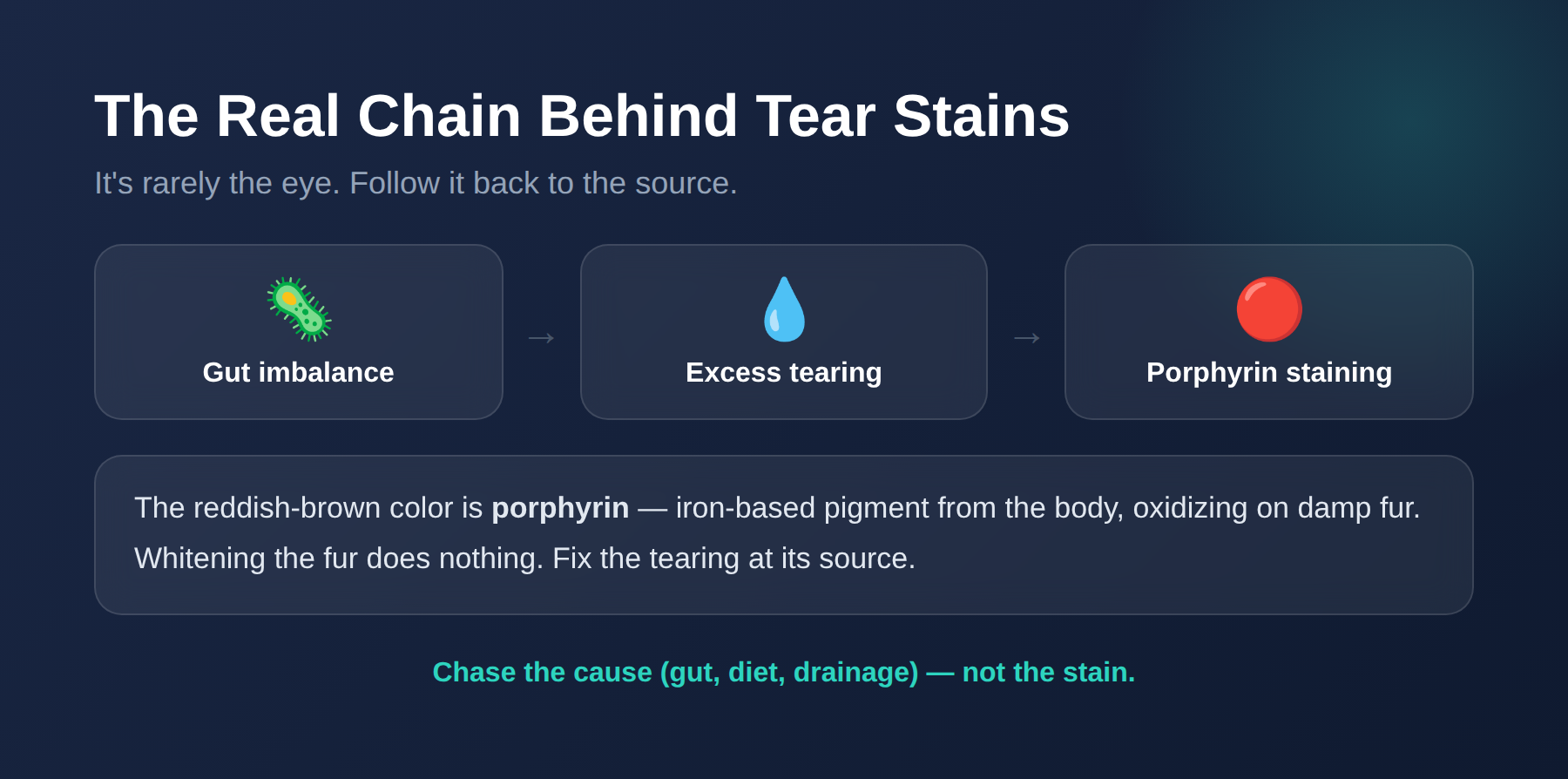
The reasoning goes like this: an imbalanced gut microbiome is thought to fuel low-grade,
body-wide inflammation. That inflammation may keep tear ducts irritated and swollen, so
tears drain poorly and spill over. It may also feed the yeast and bacteria under the eye that turn
a faint stain into a dark, crusty, smelly one. In other words —
the face may just be where you happen to see it. Part of the driver could be
in the belly — though for a lot of dogs, plain old drainage and breed anatomy explain the
whole picture on their own.
Still sounds abstract? Here’s the kind of case that makes it click.
This is a scene vets describe often — not one specific, documented case, but a pattern that
repeats: an owner brings in a light-coated dog, certain it has an eye infection.
The fur under both eyes has gone a deep, almost mahogany brown. They’ve been applying warm
compresses every morning for weeks. A groomer guessed bacteria. A well-meaning friend swore by
boric acid.
The exam takes three minutes. No discharge. No redness. No squinting. The eyes are perfectly,
completely healthy.
What looked like an infection was porphyrin that had simply been left to sit and oxidize. The eyes
were fine the whole time. The signal was coming from somewhere else.
So Where Do You Actually Start?
Not with a whitening bottle. Work through the real drivers, in this order.
1. Stop the fur from staying wet
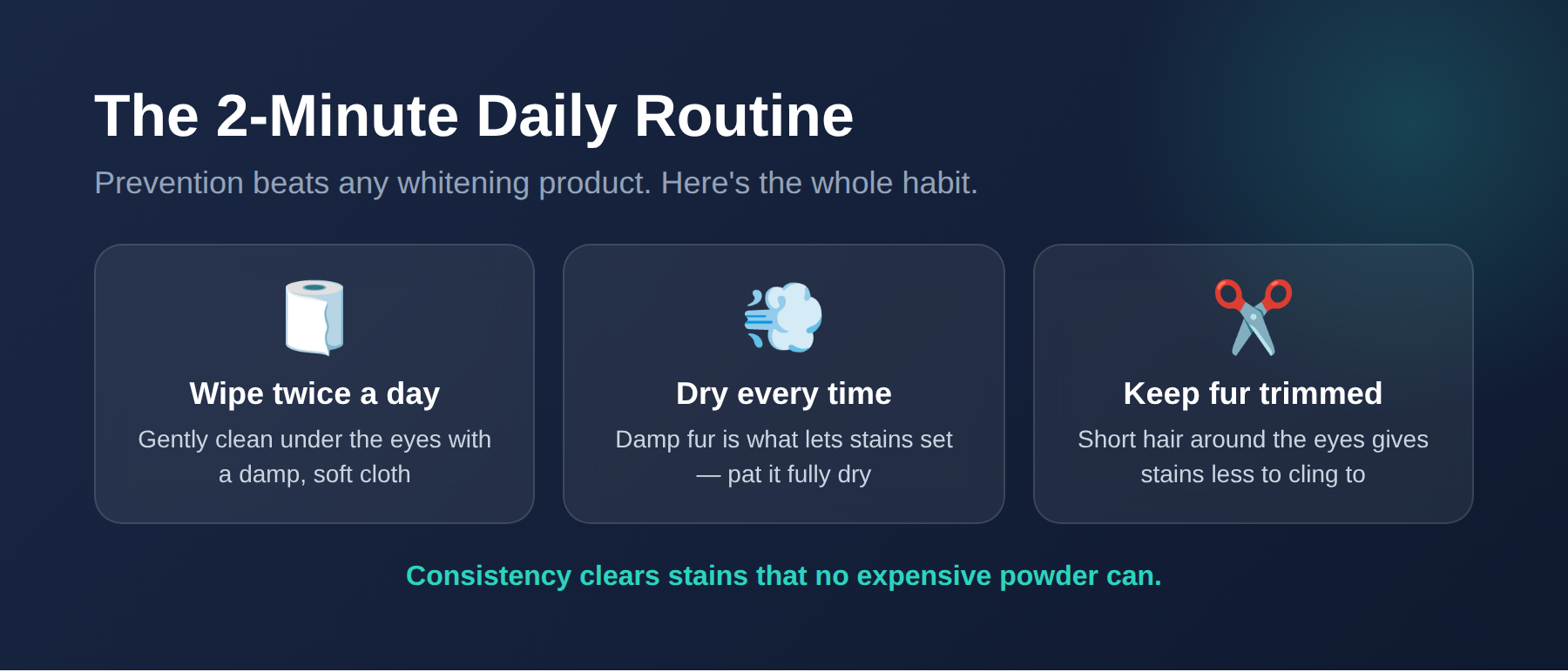
Damp fur under the eye is a greenhouse for the yeast and bacteria that darken stains. Trim the
hair short so tears drain instead of pooling, wipe the area with a damp cloth twice a
day, and — the step people skip — dry it every time. This one habit costs
nothing and does more than any product on the shelf.
2. Look hard at the bowl
What goes in can change what comes out. Mineral-heavy tap water (iron, especially) is a common
suspect, so filtered water helps some dogs. High-iron proteins like beef and heavily processed
ingredients are sometimes pointed to as well — though the “sugar feeds yeast” version of this
claim is more folk wisdom than proven science in dogs, so treat it as a reasonable thing to try,
not a confirmed cause. A simpler, cleaner, limited-ingredient diet is often what quietly turns
things around, likely by supporting the gut generally rather than removing one “bad” ingredient.
3. Rule out the plumbing
Certain breeds — Maltese, Shih Tzus, Poodles, Pugs, and other toy or flat-faced breeds — are
frequently born with narrow, shallow, or crooked tear ducts that simply can’t drain well. Blocked
ducts, ingrown lashes, and irritation do the same. If clean-and-dry plus diet doesn’t move the
needle in a few weeks, this is a vet visit, not another purchase.
The 2-Minute Routine That Actually Holds the Line
While you work on the cause, you still have to manage what’s already there. Here’s the daily habit
that keeps new stains from setting — and it takes under two minutes.
One honest line before you change anything: if your dog is rubbing its eyes,
squinting, or the eye looks red, cloudy, or painful — that’s not cosmetic. See a vet first. And
transition any new food gradually over 7–10 days; a sudden switch causes its own trouble.
The Bottom Line
- The brown color is porphyrin — a result you can see, not the cause.
- The cause is tears overflowing, driven mainly by drainage and breed anatomy, with diet playing a role.
- Gut-related inflammation is a possible contributor in some dogs — a promising lead, not a confirmed one, which is part of why “face-only” fixes keep failing.
- Start with: clean-and-dry daily, a cleaner diet, and a vet check if it won’t budge.
Stop treating the stain.
Treat the reason it keeps coming back.
Here to help you care smarter — not spend more. 🐾
Breed Risk and When Staining Isn’t Just Cosmetic
Tear overflow (epiphora) isn’t evenly distributed across dogs — anatomy loads the dice significantly.
Why some breeds are affected far more than others
Brachycephalic breeds (Shih Tzus, Maltese, Pekingese, Pugs, and similar flat-faced breeds) are disproportionately affected for a structural reason: their shortened skull shape often narrows or distorts the nasolacrimal duct — the tear drainage channel that normally carries tears from the eye down into the nose. When that duct is anatomically narrower or misaligned, tears that would normally drain internally instead overflow onto the face, where the moisture, and the porphyrin pigments naturally present in tears, cause the reddish-brown staining pattern.
This matters for expectations: a breed with this anatomy will likely need consistent management for life, not a one-time fix — the underlying drainage geometry doesn’t change with grooming or diet alone.
When staining is a sign of something beyond cosmetic overflow
Persistent tear overflow can also signal a problem worth a veterinary look rather than routine management:
- Sudden onset in a dog with no prior staining history — especially if one-sided — can indicate an eyelash abnormality (distichiasis, entropion), a corneal irritation, or a foreign body under the eyelid.
- Thick, colored, or odorous discharge (rather than clear overflow) suggests an active infection rather than simple anatomical overflow.
- Squinting, pawing at the eye, or visible redness alongside the staining points toward pain or irritation that grooming routines won’t resolve.
- Staining that worsens dramatically and quickly after being stable for a long period is worth a look, since it can mean the drainage duct has become newly blocked (by debris, inflammation, or scarring) rather than simply narrow from birth.
Routine cosmetic tear staining in an otherwise comfortable, non-squinting dog is a grooming and hygiene issue. The list above is what separates that from an eye problem that happens to also stain the fur.
A simple daily routine that actually helps
For dogs whose staining is confirmed cosmetic, consistency matters more than any single product. Wipe the area gently once a day with a clean, damp cloth or a saline solution made for the purpose — plain water works fine too. Pat dry rather than rub, since damp fur left to air-dry is exactly the moist environment that encourages the yeast overgrowth that turns simple staining into an odorous, irritated mess. Keeping the hair around the eyes trimmed short (or asking a groomer to do it regularly) reduces the surface area where tears sit against fur instead of being wiped away, and switching to a wide, shallow food and water bowl can reduce the amount of moisture trapped against the muzzle after eating or drinking. None of this changes the underlying anatomy, but it meaningfully slows how fast staining reappears between cleanings.
For general information only; not a substitute for veterinary care. If your dog shows eye redness,
discharge, cloudiness, squinting, or signs of pain, see your veterinarian before trying any product
or diet change. Background drawn from general veterinary and pet-health references (including
PetMD and VCA Animal Hospitals) on porphyrin and tear duct drainage. The gut-microbiome connection
to tear staining is an emerging area of veterinary interest, not an established diagnosis or
treatment pathway.
How this article is checked. Every claim in this article goes through a structured evidence review before publishing: checked against veterinary guidelines (AAHA, WSAVA, AVMA) and peer-reviewed veterinary research, graded for how strong the evidence actually is, and screened for overstated or missing context. Articles that don't clear this review are not published. This is general educational information, not a substitute for professional veterinary advice — always consult your vet about your individual dog.
One Comment
Comments are closed.