Senior Dog Slipping on Floors: Fix the Traction, Then Investigate the Change
Most owners do not need a longer list of possibilities. They need to know which detail changes the next move. Traction can prevent a fall today. New slipping can still be a medical clue. This guide turns that distinction into an observation plan: what to notice, what you can change safely, and when the pattern belongs with your veterinarian or a qualified behavior professional.
Treat a new slip as information
Smooth floors expose weakness, pain, poor coordination, long nails, paw problems, or vision change that carpet may hide. The details worth capturing are when the change began, which limbs slide, turning versus straight walking, and recovery after a slip. Those observations describe a sequence rather than forcing one moment into a diagnosis. Note what changed first and how long the dog needed to return to baseline.
Start here: record short videos of ordinary movement and schedule evaluation for a new trend. Keep the setup easy enough that safety and choice remain intact. Do not dismiss repeated slipping as age alone. If the response worsens after the change, undo the added difficulty and reassess the premise.
Create a continuous safe route
One small mat in the middle of a slick room does not help if the dog must cross bare floor to reach it. Watch for routes to bed, water, door, stairs, and favorite resting areas. The earliest change is usually more actionable than the loudest part of the event, because it shows where prevention was still possible.
build connected traction lanes with secured runners or mats. Then compare intensity, duration, and recovery with the previous occurrence. Loose rugs can become another hazard. A plan earns another attempt only when the dog remains physically safe and the trend is stable or improving.
Check nails, paws, and fur
Long nails alter contact; overgrown fur between pads can reduce grip; sore pads can change weight bearing. For an owner, the usable evidence is concrete: nail length, pad injury, interdigital irritation, broken nails, and uneven wear. Write those details down without deliberately recreating the problem. A natural event observed safely is enough.
The next move: ask a groomer or veterinary team for safe trimming help when needed. This is a management or learning step, not proof of a diagnosis. Do not cut painful or abnormal nails without guidance. When a physical sign appears alongside the pattern, the medical question moves ahead of further practice.
Watch transitions, not only walking
Rising, sitting, turning, and stepping over thresholds often reveal difficulty before a straight hallway does. Do not judge it from one dramatic snapshot. Instead, compare hesitation, repeated attempts, splayed legs, knuckling, toe dragging, and asymmetry. Context can change the meaning of the same outward behavior.
A reasonable first response is to film these movements from the side without forcing repetitions. Give that change a fair but safe trial, and stop before distress or injury becomes the price of information. Videos support an exam; they do not identify the cause by themselves. Improvement should look like easier recovery, not mere suppression.
Choose aids by the job
Traction socks, nail grips, rugs, harnesses, ramps, and steps solve different mechanical problems. The distinction becomes clearer when you track whether the dog tolerates the aid, skin contact, fit, and the exact movement needing support. This is especially useful when several people handle the dog and remember the event differently.
Practical decision: start with the least intrusive option that solves the observed job. Change only what the dog can tolerate without force. A product that changes gait or causes rubbing should be removed. If the household cannot maintain that boundary consistently, professional help becomes part of risk management rather than a last resort.
Keep movement controlled, not absent
Complete inactivity can reduce conditioning, while uncontrolled sprints on slick floors add fall risk. Before adding a product or a harder exercise, look at stamina, soreness after activity, willingness, breathing, and next-day function. These signs tell you whether the present setup is workable.
ask the veterinarian for an activity plan and use predictable, low-slip routes. Recheck the same markers afterward instead of relying on whether the dog simply became quieter. Exercise prescriptions depend on the diagnosis and individual dog. Quiet behavior can reflect comfort, fatigue, freezing, or learned inhibition; the surrounding pattern decides which explanation is plausible.
Look beyond arthritis
Orthopedic pain is common, but neurologic disease, muscle loss, vision impairment, medication effects, and systemic illness can also alter movement. The details worth capturing are knuckling, crossing limbs, head tilt, collapse, marked weakness, and rapid progression. Those observations describe a sequence rather than forcing one moment into a diagnosis. Note what changed first and how long the dog needed to return to baseline.
Start here: seek prompt assessment when coordination or strength changes. Keep the setup easy enough that safety and choice remain intact. Sudden inability to stand, paralysis, severe pain, or collapse is an emergency. If the response worsens after the change, undo the added difficulty and reassess the premise.
Track quality of life through function
Useful outcomes are concrete: reaching water, toileting, rising, sleeping, and joining family activity. Watch for good and difficult days, assistance needed, falls, appetite, sleep, and engagement. The earliest change is usually more actionable than the loudest part of the event, because it shows where prevention was still possible.
review the log with the veterinary team and adjust the plan. Then compare intensity, duration, and recovery with the previous occurrence. A single cheerful moment does not erase persistent functional loss. A plan earns another attempt only when the dog remains physically safe and the trend is stable or improving.
Spend in the right order
The first purchase should address the observed barrier, while clinical evaluation explains why the barrier appeared. For an owner, the usable evidence is concrete: which route or movement fails and whether a simple environmental change fixes it. Write those details down without deliberately recreating the problem. A natural event observed safely is enough.
The next move: secure traction first, then buy specialized aids only when their job is clear. This is a management or learning step, not proof of a diagnosis. Revenue may reorder this article’s queue; it does not justify unnecessary equipment. When a physical sign appears alongside the pattern, the medical question moves ahead of further practice.
Your decision map
For senior dog slipping on floors, the sequence below keeps action attached to evidence instead of a guess. Its fixed point is simple: Traction can prevent a fall today. New slipping can still be a medical clue.
- Treat a new slip as information: record short videos of ordinary movement and schedule evaluation for a new trend. Reassess by watching when the change began, which limbs slide, turning versus straight walking, and recovery after a slip.
- Create a continuous safe route: build connected traction lanes with secured runners or mats. Reassess by watching routes to bed, water, door, stairs, and favorite resting areas.
- Check nails, paws, and fur: ask a groomer or veterinary team for safe trimming help when needed. Reassess by watching nail length, pad injury, interdigital irritation, broken nails, and uneven wear.
- Watch transitions, not only walking: film these movements from the side without forcing repetitions. Reassess by watching hesitation, repeated attempts, splayed legs, knuckling, toe dragging, and asymmetry.
- Choose aids by the job: start with the least intrusive option that solves the observed job. Reassess by watching whether the dog tolerates the aid, skin contact, fit, and the exact movement needing support.
- Keep movement controlled, not absent: ask the veterinarian for an activity plan and use predictable, low-slip routes. Reassess by watching stamina, soreness after activity, willingness, breathing, and next-day function.
If these steps cannot be carried out without triggering when the change began, which limbs slide, turning versus straight walking, and recovery after a slip, stop increasing the challenge. That result is enough to justify a safer setup and a case-specific conversation; the dog does not need to fail more dramatically first.
Quick decision questions
Which change matters first?
For senior dog slipping on floors, begin with this observable distinction: routes to bed, water, door, stairs, and favorite resting areas. The first low-risk response is to build connected traction lanes with secured runners or mats. If that cannot be done without provoking the problem, move the case out of trial-and-error mode.
What belongs in the record?
Track whether the dog tolerates the aid, skin contact, fit, and the exact movement needing support. Add the time needed to recover and any change in appetite, sleep, movement, elimination, or social behavior. Record naturally occurring events; do not stage a stronger version for the camera.
When does outside help move forward?
A single cheerful moment does not erase persistent functional loss. A useful handoff includes what triggered the event, what reduced it, and what happened after review the log with the veterinary team and adjust the plan.
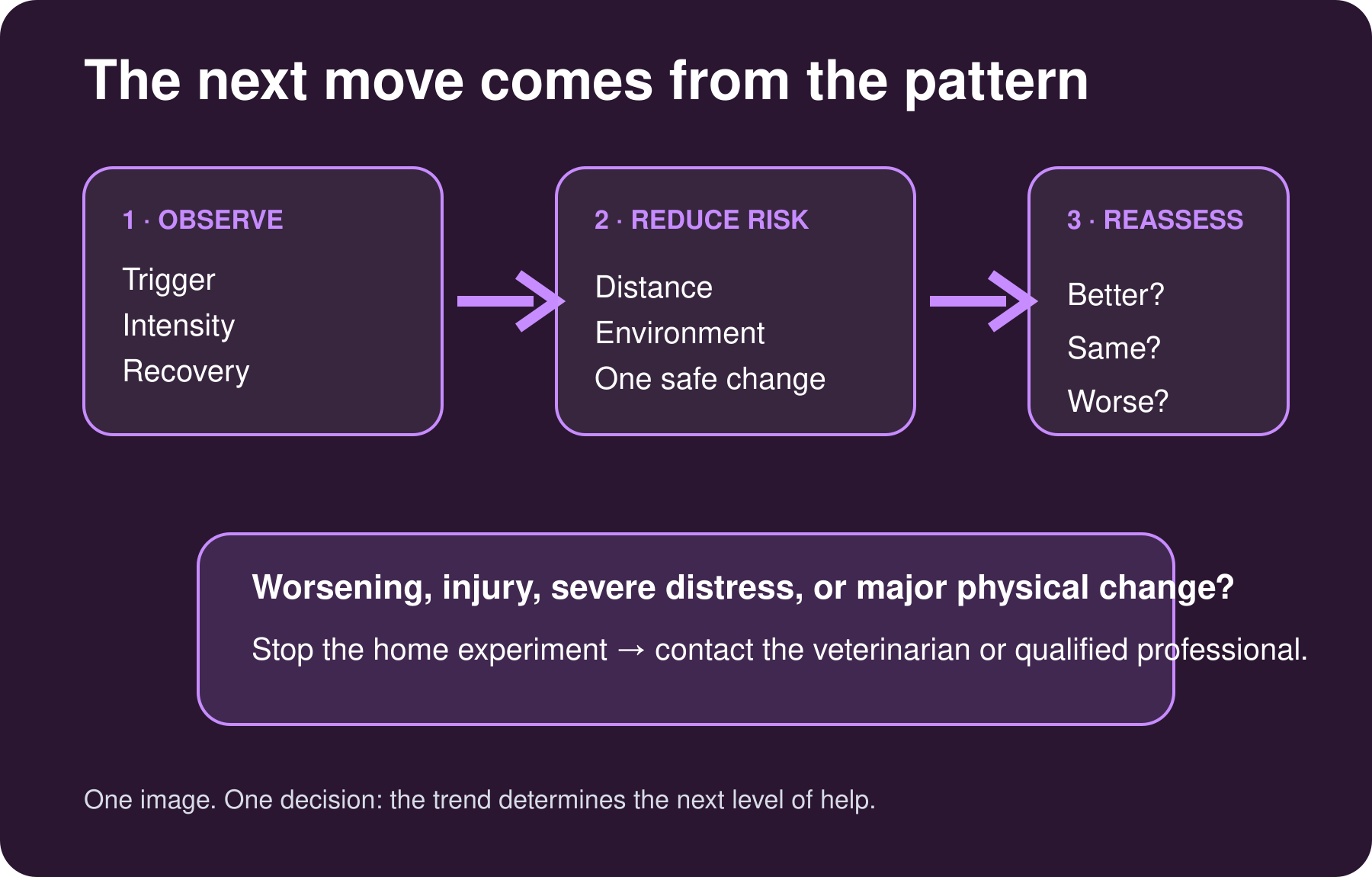
What to bring to the next conversation
Bring a concise record tied to this article’s question: senior dog slipping on floors. Include when the pattern began, the first observable change, the most difficult context, what reliably reduces intensity, how long recovery takes, and whether appetite, sleep, movement, elimination, breathing, or social behavior changed at the same time.
For “Senior Dog Slipping on Floors: Fix the Traction, Then Investigate the Change,” list each management step already tried and what followed. That prevents a veterinary or behavior visit from beginning with vague descriptions such as “better” or “worse.” It also shows whether improvement followed the planned change or merely coincided with the trigger disappearing.
Keep the main conclusion visible while you collect details: Traction can prevent a fall today. New slipping can still be a medical clue. New information should refine that decision, not erase safety boundaries. If a recommendation depends on diagnosis, exercise capacity, calorie target, medication, or a controlled behavior setup, leave it with the professional who can examine the dog and review the history.
The 2023 AAHA Senior Care Guidelines source supports this decision framework, but guidance for a population cannot predict one dog’s outcome. Claim strength must remain unchanged after SEO, visual design, and editing. For senior dog slipping on floors, the aim is a defensible next move—not a confident-sounding diagnosis.
Do not delay that conversation merely to complete a perfect record of which route or movement fails and whether a simple environmental change fixes it. Worsening signs, injury, severe distress, or loss of normal function deserves timely care with the information already available.
Sources
How this article is checked. Every claim in this article goes through a structured evidence review before publishing: checked against veterinary guidelines (AAHA, WSAVA, AVMA) and peer-reviewed veterinary research, graded for how strong the evidence actually is, and screened for overstated or missing context. Articles that don't clear this review are not published. This is general educational information, not a substitute for professional veterinary advice — always consult your vet about your individual dog.