Resource Guarding in Dogs: What to Do Before a Warning Becomes a Bite
Most owners do not need a longer list of possibilities. They need to know which detail changes the next move. A growl is information. Creating distance is the first useful response—not proving that you can take the item. This guide turns that distinction into an observation plan: what to notice, what you can change safely, and when the pattern belongs with your veterinarian or a qualified behavior professional.
Start with safety, not a test
Guarding can involve food, chews, toys, resting places, stolen objects, or even a person. The meaningful pattern is tension or threat when someone approaches a valued resource. Do not judge it from one dramatic snapshot. Instead, compare stiffening, freezing, hovering, hard staring, eating faster, lip lifting, growling, snapping. Context can change the meaning of the same outward behavior.
A reasonable first response is to stop approaching; keep children and visitors away; use barriers and management. Give that change a fair but safe trial, and stop before distress or injury becomes the price of information. Do not repeatedly provoke the behavior to see how serious it is. Each rehearsal can increase risk. Improvement should look like easier recovery, not mere suppression.
Do not punish the warning
A growl gives you a chance to change course before contact occurs. Punishing it may suppress the signal without removing fear or conflict. The distinction becomes clearer when you track whether the dog warns earlier with subtle body tension before vocalizing. This is especially useful when several people handle the dog and remember the event differently.
Practical decision: back away calmly and note the distance, resource, and context. Change only what the dog can tolerate without force. Silence after punishment does not prove the dog feels safer. If the household cannot maintain that boundary consistently, professional help becomes part of risk management rather than a last resort.
Management buys safe learning time
Management means preventing predictable confrontations while a plan is built. It is not surrender. Before adding a product or a harder exercise, look at which objects trigger guarding and which household routines create close approaches. These signs tell you whether the present setup is workable.
feed in a quiet area, pick up high-value items when the dog is elsewhere, and use gates. Recheck the same markers afterward instead of relying on whether the dog simply became quieter. Never ask a child to trade with or approach a guarding dog. Quiet behavior can reflect comfort, fatigue, freezing, or learned inhibition; the surrounding pattern decides which explanation is plausible.
Trading is different from grabbing
A trade works when the dog voluntarily leaves the item for something worthwhile and does not feel trapped. The details worth capturing are loose muscles, turning away from the item, and willingness to re-engage after the exchange. Those observations describe a sequence rather than forcing one moment into a diagnosis. Note what changed first and how long the dog needed to return to baseline.
Start here: begin with low-stakes objects and toss the reward away from the item. Keep the setup easy enough that safety and choice remain intact. If the dog freezes, rushes back, or escalates, the exercise is too difficult. If the response worsens after the change, undo the added difficulty and reassess the premise.
Change the meaning of an approach
Counterconditioning pairs a safe, subthreshold approach with something the dog values. The goal is a changed emotional response, not forced tolerance. Watch for the distance at which the dog remains relaxed and can eat normally. The earliest change is usually more actionable than the loudest part of the event, because it shows where prevention was still possible.
work below that threshold and end before tension appears. Then compare intensity, duration, and recovery with the previous occurrence. Progress should be individualized; severe cases need professional design. A plan earns another attempt only when the dog remains physically safe and the trend is stable or improving.
Look for pain and medical change
New guarding, especially around handling or resting, can occur when movement or touch hurts. For an owner, the usable evidence is concrete: sudden onset, limping, flinching, sleep disruption, appetite change, or guarding one body area. Write those details down without deliberately recreating the problem. A natural event observed safely is enough.
The next move: schedule a veterinary examination when behavior changes abruptly or pain is plausible. This is a management or learning step, not proof of a diagnosis. Training cannot resolve untreated pain. When a physical sign appears alongside the pattern, the medical question moves ahead of further practice.
Choose qualified help early
A bite history, rapid escalation, household children, or guarding of many contexts raises the stakes. Do not judge it from one dramatic snapshot. Instead, compare bite contact, puncture, pursuit after retreat, unpredictability, and inability to manage exposure. Context can change the meaning of the same outward behavior.
A reasonable first response is to contact your veterinarian and a credentialed behavior professional who uses reward-based methods. Give that change a fair but safe trial, and stop before distress or injury becomes the price of information. Remote tips are not a substitute for a case-specific safety plan. Improvement should look like easier recovery, not mere suppression.
Track patterns without staging them
Useful records come from naturally occurring events, not deliberate tests. The distinction becomes clearer when you track resource, distance, person, body language, outcome, and recovery time. This is especially useful when several people handle the dog and remember the event differently.
Practical decision: write a brief log and, only when safe, capture video from a distance. Change only what the dog can tolerate without force. Do not place yourself near the dog to obtain better footage. If the household cannot maintain that boundary consistently, professional help becomes part of risk management rather than a last resort.
Know the emergency line
Most guarding is managed through distance and planned support, but injuries need medical attention. Before adding a product or a harder exercise, look at a bite to a child, face or hand; deep puncture; uncontrolled bleeding; or an attack that does not stop. These signs tell you whether the present setup is workable.
separate safely without reaching between dogs and seek urgent human or veterinary care as appropriate. Recheck the same markers afterward instead of relying on whether the dog simply became quieter. Call emergency services for severe human injury and a veterinarian for injured animals. Quiet behavior can reflect comfort, fatigue, freezing, or learned inhibition; the surrounding pattern decides which explanation is plausible.
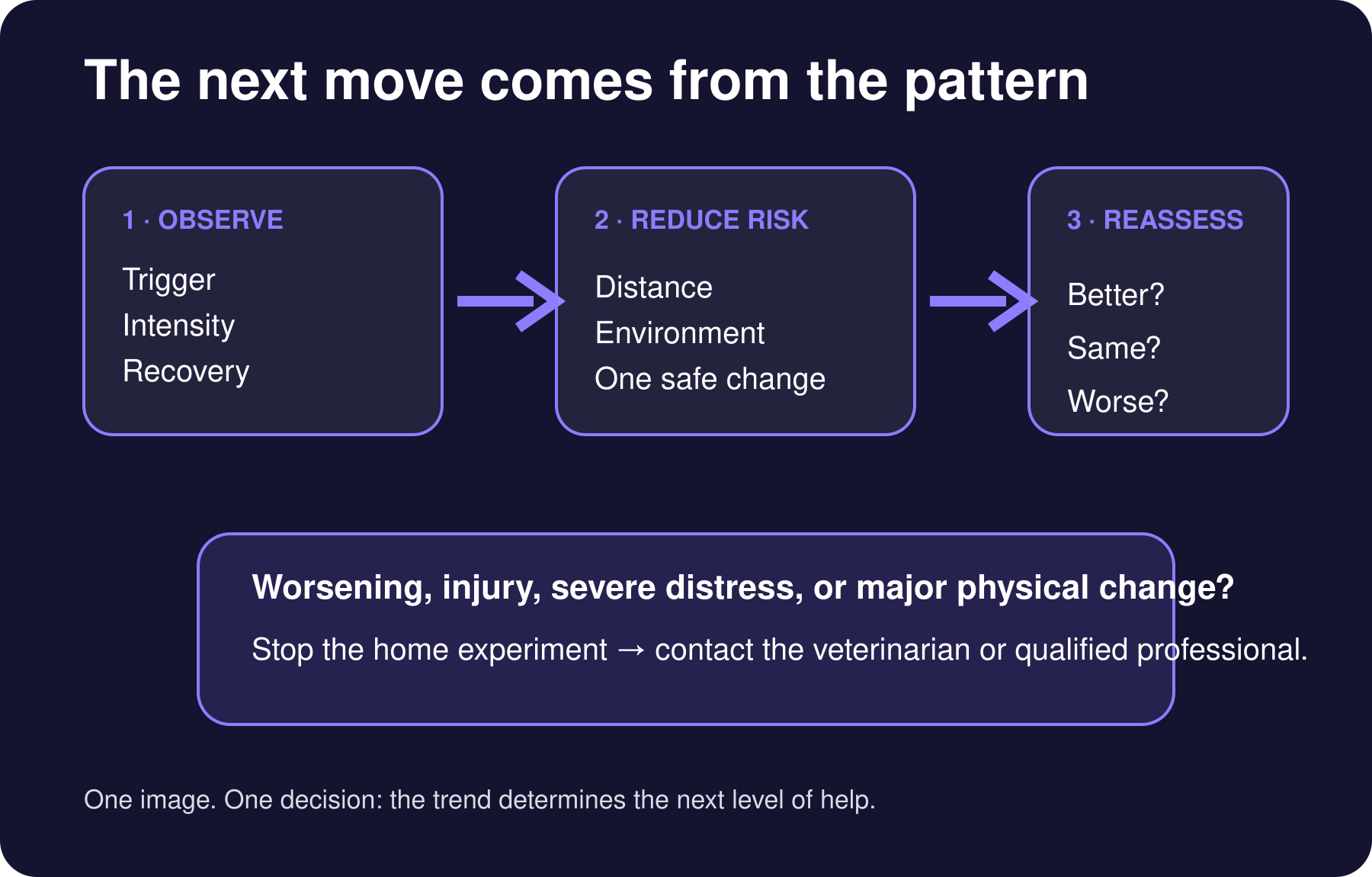
Your decision map
For dog resource guarding what to do, the sequence below keeps action attached to evidence instead of a guess. Its fixed point is simple: A growl is information. Creating distance is the first useful response—not proving that you can take the item.
- Start with safety, not a test: stop approaching; keep children and visitors away; use barriers and management. Reassess by watching stiffening, freezing, hovering, hard staring, eating faster, lip lifting, growling, snapping.
- Do not punish the warning: back away calmly and note the distance, resource, and context. Reassess by watching whether the dog warns earlier with subtle body tension before vocalizing.
- Management buys safe learning time: feed in a quiet area, pick up high-value items when the dog is elsewhere, and use gates. Reassess by watching which objects trigger guarding and which household routines create close approaches.
- Trading is different from grabbing: begin with low-stakes objects and toss the reward away from the item. Reassess by watching loose muscles, turning away from the item, and willingness to re-engage after the exchange.
- Change the meaning of an approach: work below that threshold and end before tension appears. Reassess by watching the distance at which the dog remains relaxed and can eat normally.
- Look for pain and medical change: schedule a veterinary examination when behavior changes abruptly or pain is plausible. Reassess by watching sudden onset, limping, flinching, sleep disruption, appetite change, or guarding one body area.
If these steps cannot be carried out without triggering stiffening, freezing, hovering, hard staring, eating faster, lip lifting, growling, snapping, stop increasing the challenge. That result is enough to justify a safer setup and a case-specific conversation; the dog does not need to fail more dramatically first.
Quick decision questions
Which change matters first?
For dog resource guarding what to do, begin with this observable distinction: whether the dog warns earlier with subtle body tension before vocalizing. The first low-risk response is to back away calmly and note the distance, resource, and context. If that cannot be done without provoking the problem, move the case out of trial-and-error mode.
What belongs in the record?
Track the distance at which the dog remains relaxed and can eat normally. Add the time needed to recover and any change in appetite, sleep, movement, elimination, or social behavior. Record naturally occurring events; do not stage a stronger version for the camera.
When does outside help move forward?
Do not place yourself near the dog to obtain better footage. A useful handoff includes what triggered the event, what reduced it, and what happened after write a brief log and, only when safe, capture video from a distance.
Sources
How this article is checked. Every claim in this article goes through a structured evidence review before publishing: checked against veterinary guidelines (AAHA, WSAVA, AVMA) and peer-reviewed veterinary research, graded for how strong the evidence actually is, and screened for overstated or missing context. Articles that don't clear this review are not published. This is general educational information, not a substitute for professional veterinary advice — always consult your vet about your individual dog.