
Dog Urinating More Than Usual? Here’s How to Tell Accident, Infection, or Emergency Apart
The wet patch on the dog bed wasn’t there this morning. Your dog is asleep when you find it — not squatting, not looking guilty, just asleep. That’s a different problem than the puddle by the door that happened because nobody let her out in time.
“My dog is urinating more” can mean three genuinely different things, and they call for three different responses. Getting them confused is where a lot of well-meaning owners go wrong — either scolding a dog for something it can’t control, or calmly waiting out what’s actually a medical emergency.
Quick answer: If your dog is actively urinating more often, in different places, or in larger puddles — but still clearly aware and trying to go — think infection, PU/PD (drinking-and-urination) causes, or behavior. If your dog is leaking without seeming to notice, especially while resting or asleep, think incontinence. If your dog is straining hard and producing little or nothing, treat it as an emergency and call your vet immediately — that combination can mean a blocked urinary tract.
Dog Urinating More Than Usual? Three Different Problems
Owners searching “why is my dog peeing so much” are often describing three different experiences that all land under the same phrase:
- House soiling: your dog is aware, actively squats or lifts a leg, and chooses (or is forced by timing/urgency) to go somewhere they shouldn’t.
- Urinary incontinence: urine leaks out without your dog appearing to notice or control it — while lying down, sleeping, or just standing around. This is not a training problem, and treating it like one doesn’t work and isn’t fair to the dog.
- Increased frequency with awareness: your dog is actively asking to go out far more than usual, and each trip may produce a normal, reduced, or larger-than-usual amount.
The distinction matters because the first is often a training or opportunity problem, the second is almost always medical, and the third has a wide list of possible causes — from a straightforward bladder infection to something that needs same-day attention.
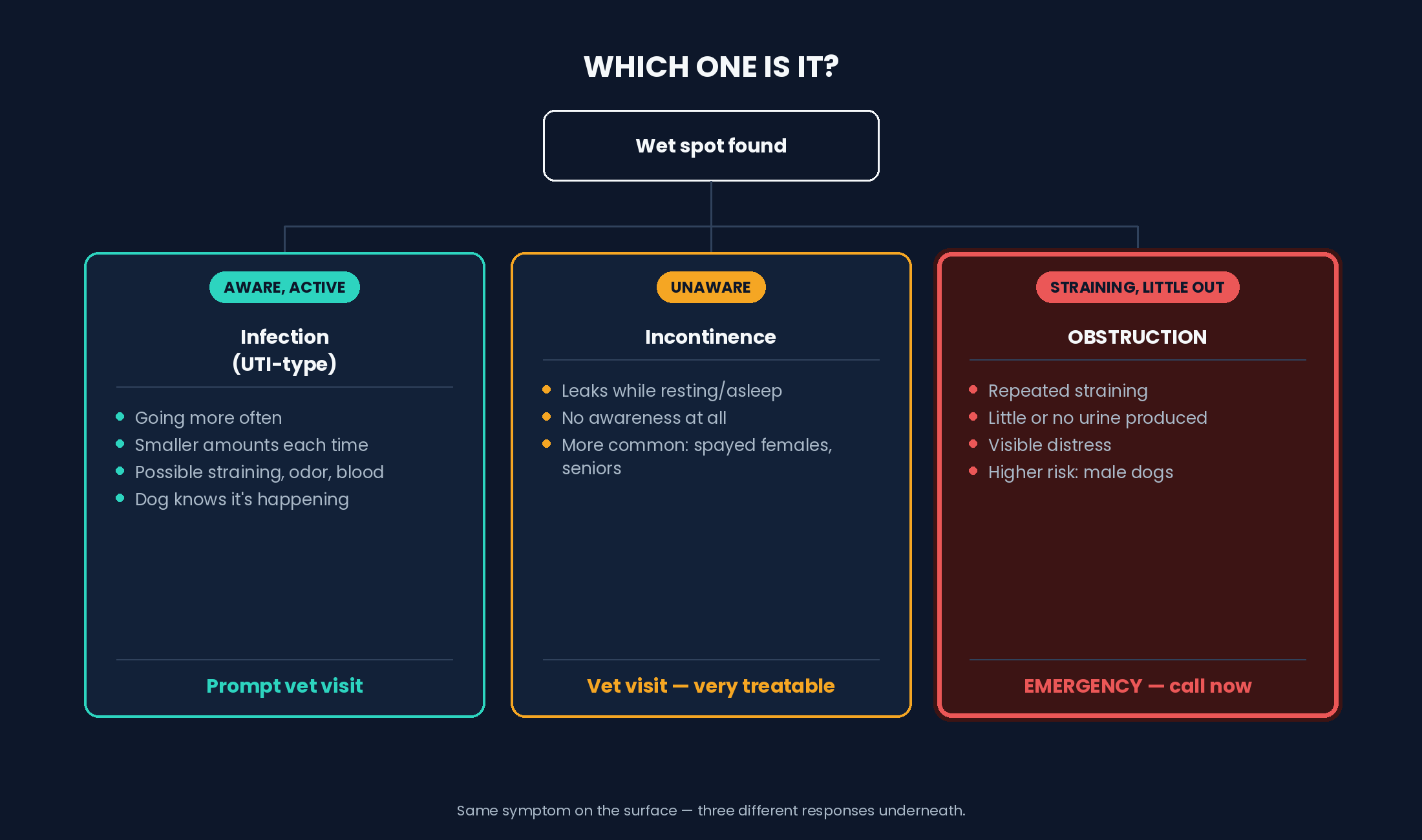
Is It Incontinence? The Tell Is “Did They Know?”
True urinary incontinence looks different from an accident. The classic pattern is a wet spot appearing under a dog that was simply lying down or sleeping — not a puddle where a dog stood, squatted, and walked away. Owners often describe finding a damp patch on the bed or blanket after the dog gets up, with no sign the dog was aware anything happened.
Incontinence is more common in spayed female dogs — a weakened urethral sphincter is a well-recognized cause, particularly in medium-to-large breeds — and it’s also more frequent in senior dogs of either sex. Certain breeds, including Irish Setters, Dobermanns, Bearded Collies, Rough Collies, and Dalmatians, are reported more often, though this points to a predisposition worth being aware of, not a certainty for any individual dog.
Incontinence is very treatable in many cases — this isn’t a “just live with it” diagnosis. But it does need an actual veterinary visit, because the underlying cause (hormone-responsive sphincter weakness, a UTI irritating the bladder, a neurological issue, or something else) changes the treatment completely.
Is It a UTI? Look at Volume, Not Just Frequency
Urinary tract infections are common — they’re estimated to affect roughly 14% of dogs at some point, most often caused by bacteria (commonly E. coli) that travel up the urethra into the bladder. Female dogs are disproportionately affected because of their shorter urethra, which gives bacteria a shorter path to travel.
The classic UTI pattern is different from incontinence: your dog is fully aware and actively trying to urinate — often more frequently, but producing smaller amounts each time, sometimes with visible straining, whimpering, cloudy urine, a strong odor, or blood. A dog with a UTI knows it’s urinating; a dog with incontinence often doesn’t know it happened at all.
A suspected UTI is worth a prompt veterinary visit rather than a wait-and-see approach — left untreated, a bladder infection can travel further up into the kidneys and become a more serious, harder-to-treat problem.
When “Straining and Nothing Coming Out” Is an Emergency
This is the pattern that separates an inconvenient problem from a true emergency: your dog is straining repeatedly, visibly uncomfortable, and producing little or no urine at all.
That combination can mean a urethral obstruction — often from a bladder stone that has moved into the urethra and physically blocked the flow of urine. This is especially urgent in male dogs, whose narrower, longer urethra is more easily blocked. A fully blocked bladder is a genuine emergency: it can become life-threatening within hours as waste products build up in the bloodstream.
If your dog is straining to urinate and little or nothing is coming out, this is not a “monitor overnight” situation. Contact an emergency vet immediately.
Could It Be Behavioral?
Not every accident is medical. Submissive or excitement urination — a small leak when greeting people, during play, or when a dog feels anxious or overwhelmed — is a recognized behavioral pattern, more common in puppies and small breeds. Territorial marking (usually small amounts on vertical surfaces) is a different behavior again, and more common in intact males.
The catch: behavioral causes can look similar to medical ones on the surface, which is exactly why a veterinarian typically starts with a urinalysis rather than assuming either explanation. A dog that “just gets excited” and a dog with an early UTI can produce a similar-looking small accident by the door.
What to Track Before the Vet Visit
A short, specific record helps your vet sort through these possibilities faster than a general impression does:
- Aware or unaware? Did your dog seem to know it happened, or did you just find a wet spot?
- Volume pattern: Normal-sized trips more often, or frequent small dribbles?
- Straining? Any visible effort, whimpering, or repeated attempts producing little urine?
- Appearance: Any blood, cloudiness, or strong odor you’ve noticed?
- Context: Does it happen mainly at rest, during excitement, or randomly through the day?
- Anything else changed? Thirst, appetite, weight, energy level, or new accidents in a previously reliable dog?
If thirst has increased alongside urination, that combination points toward the broader PU/PD picture — worth reading alongside our guide to increased drinking, since the two often need to be considered together rather than as separate symptoms.
What Your Vet Will Likely Do First
A urinalysis is usually the starting point — checking for bacteria, blood, crystals, and how concentrated or dilute the urine is. That single test already separates several possibilities: bacteria and inflammatory cells point toward infection, crystals point toward stone-forming risk, and very dilute urine shifts the conversation toward the PU/PD causes covered in our water-intake guide rather than a straightforward bladder problem.
Depending on what the urinalysis shows, a urine culture (to identify the exact bacteria and the antibiotic it will actually respond to), bloodwork, or imaging — an X-ray or ultrasound to look for stones, thickened bladder walls, or masses — may follow. For a first-time, straightforward-looking UTI in an otherwise healthy adult dog, this workup is often quick and inexpensive. For recurring problems, incontinence, or anything with straining involved, the workup is more thorough for good reason: recurring symptoms usually mean the first, simplest explanation wasn’t the whole story.
Which Dogs Carry More Risk for the Emergency Version
Urethral obstruction from bladder stones is not evenly distributed across all dogs. Male dogs carry meaningfully higher risk than females for true blockage, simply because of anatomy — a male dog’s urethra is longer, narrower, and has a natural narrowing point near the bone at the base of the penis, which is exactly where a stone tends to lodge. A female dog can develop the same stones without producing a blockage, because her urethra is shorter and wider.
Certain breeds are also reported more often with stone-forming tendencies — Miniature Schnauzers, Dalmatians, Bulldogs, and several small terrier breeds among them — though diet, hydration, and individual urine chemistry all play a role alongside breed tendency. None of this changes the core rule: in any dog, straining with little or no output is an emergency call, not a wait-and-watch situation.
Reducing the Odds Between Now and the Vet Visit
None of the following replaces a diagnosis, but they’re reasonable, low-risk steps while you’re getting your dog seen:
- Keep fresh water available and don’t restrict it — even if the extra urination is inconvenient, cutting off water can worsen a UTI or make crystal formation more likely, not less.
- Offer more frequent bathroom trips rather than asking a possibly-infected or irritated bladder to hold longer than usual.
- Skip home remedies aimed at “flushing” the bladder — cranberry supplements and similar products lack strong dog-specific evidence for treating an active infection, and delaying an actual diagnosis to try one isn’t a safe trade.
- Don’t start an antibiotic left over from a previous prescription — the wrong antibiotic, or the wrong dose, can make a bacterial culture harder to interpret later and doesn’t guarantee it matches whatever bacteria is actually present this time.
What Not to Do
Don’t scold or punish a dog for what turns out to be incontinence. A dog that doesn’t know it’s leaking cannot learn from correction — it isn’t a behavior problem, and treating it like one damages trust without solving anything.
Don’t wait out straining with no output. This is the one pattern in this article where “give it a day and see” is genuinely dangerous advice.
Don’t assume an older dog’s new accidents are “just age.” New house-soiling in a previously reliable senior dog is exactly the kind of change worth a vet visit rather than a shrug — see our guide on senior dog signs for more on why “just getting old” so often hides something treatable.
The Short Version
Aware and active, but going more often or in smaller amounts: think infection first.
Leaking without seeming to notice, especially at rest: think incontinence, and get it checked rather than trained.
Straining hard with nothing coming out: that’s an emergency, tonight, not tomorrow.
Getting the category right is most of the work — the right response follows naturally once you know which of these three you’re actually looking at.
Sources
- Vetster: Urinary incontinence in dogs — signs and treatment options
- PetMD: UTI in Dogs — Signs, Causes, and Treatment
- PetMD: 8 Common Urinary Problems in Dogs
- Dr. Buzby’s ToeGrips: UTI in Dogs — Know the Signs, Treatments, Prevention
- Joii Pet Care: House soiling (urine) in dogs
What should you read next?
How this article is checked. Every claim in this article goes through a structured evidence review before publishing: checked against veterinary guidelines (AAHA, WSAVA, AVMA) and peer-reviewed veterinary research, graded for how strong the evidence actually is, and screened for overstated or missing context. Articles that don't clear this review are not published. This is general educational information, not a substitute for professional veterinary advice — always consult your vet about your individual dog.
One Comment
Comments are closed.