Dog Drinking More Water Than Usual? The Change Matters More Than the Number
You fill the bowl at breakfast. By lunch, it is empty. Then your dog wakes you at 2 a.m. to go outside.
Maybe it is August. Maybe you switched from canned food to kibble. Maybe nothing obvious changed.
One thirsty day is easy to explain. A new drinking-and-peeing pattern is different.
The number is useful. Your dog’s baseline is better.
Water intake moves around for perfectly normal reasons. Hot weather and harder exercise raise it. Dogs eating mostly dry food usually drink more from the bowl than dogs getting a lot of moisture from canned food. Even day-to-day activity can move the number.
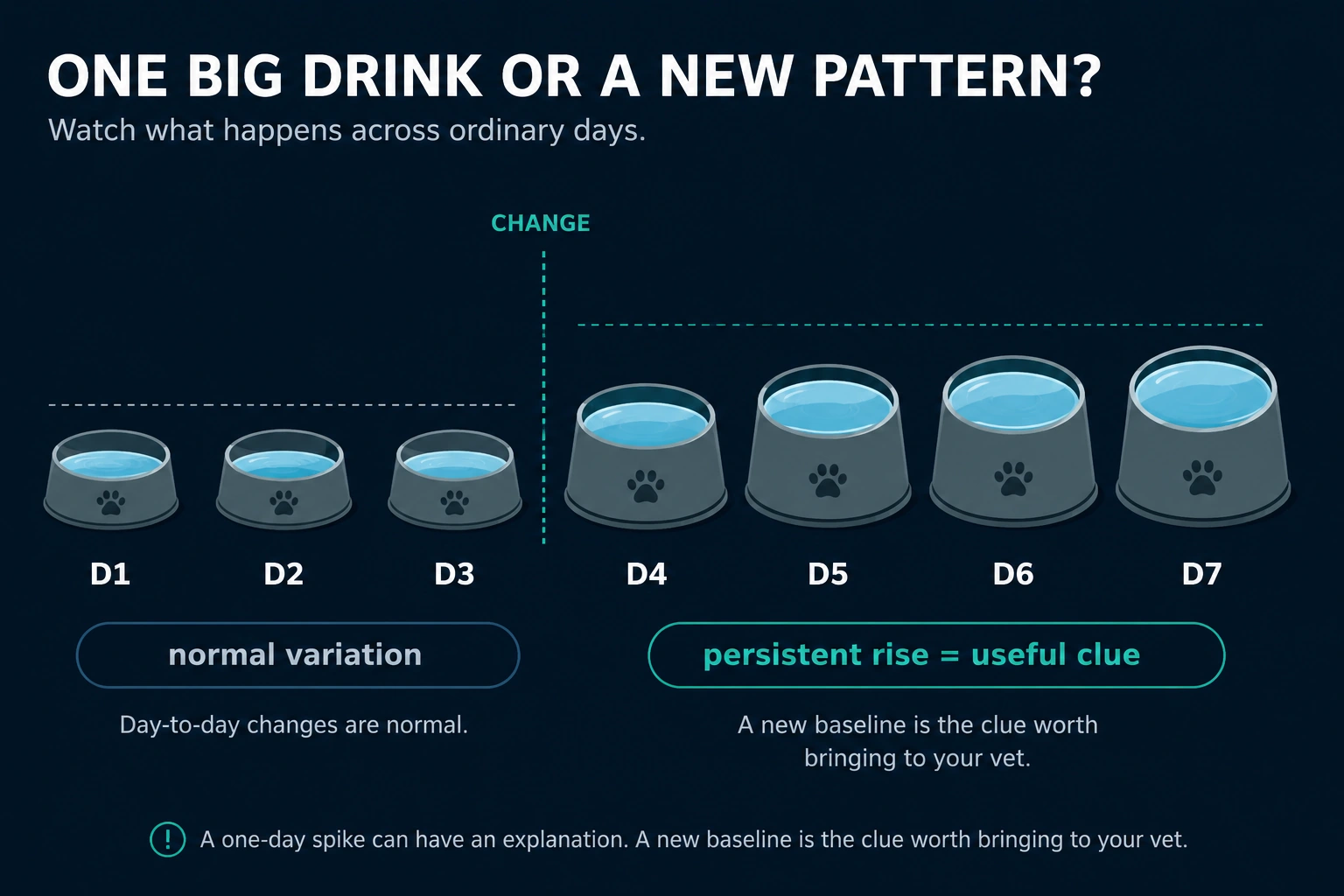
That is why a single measurement can mislead. A dog can have a higher-than-usual day and still be normal. What gets more interesting is a pattern that remains higher after the obvious trigger is gone.
For a rough sense of scale, the usual 40–60 mL/kg/day range works out like this:
- 5 kg (11 lb): about 200–300 mL per day
- 10 kg (22 lb): about 400–600 mL per day
- 20 kg (44 lb): about 800–1,200 mL per day
- 30 kg (66 lb): about 1,200–1,800 mL per day
The commonly used polydipsia threshold of more than 100 mL/kg/day would be more than 500 mL for a 5 kg dog, more than 1 liter for a 10 kg dog, and more than 2 liters for a 20 kg dog.
Those numbers are not a home diagnostic test. They are context. A dog that normally drinks 700 mL and suddenly settles at 1,300 mL for several ordinary days has changed, even if the number is still below the classic cutoff for that dog’s weight.
That is the piece owners can miss when they search for one “too much” number. The threshold helps define marked excess. The baseline helps you notice change earlier.
Why the water bowl and the yard usually change together
Owners often notice the drinking first. Physiologically, the order is often the other way around.
Many medical problems make a dog produce more urine. The body then asks for more water to replace what is being lost. Veterinarians call the pair polyuria/polydipsia, often shortened to PU/PD.
That changes the question. Instead of asking only, “Why is my dog so thirsty?” also look at what is happening at the other end: longer pees, more frequent trips outside, nighttime requests, or new accidents in a previously house-trained dog.
A bigger water bowl without a bigger urine pattern is still worth noting, but the two together are more informative. If your dog now needs to go out at midnight, produces noticeably larger puddles, or has started having accidents after years of reliable house training, write that down. It gives your veterinarian more than “she seems thirsty.”
Start with the ordinary explanations—but make sure they actually fit
Heat, exercise, and diet can explain a temporary increase. A long hike on a warm day should change water needs. So can a move from canned food to dry kibble, because more of the dog’s water now has to come from the bowl instead of the food.
The useful test is whether the story closes cleanly.
Hard exercise yesterday, more drinking afterward, back to normal today? That makes sense. A hotter week with more panting and more water, then a return toward baseline as temperatures drop? Also plausible.
But if the environmental explanation ends and the thirst does not, the picture changes. “It has been warm” becomes less convincing when the dog is still emptying the bowl at the same rate during cooler, ordinary days.
This is why a short record beats memory. We are not very good at reconstructing how often a bowl was filled three days ago. A few measured days can turn a vague impression into a pattern.
When the pattern persists, these are the causes vets think about
A persistent increase in both drinking and urination has a broad differential. Among the common medical causes veterinarians consider are diabetes mellitus, Cushing’s disease, and chronic kidney disease. Other possibilities include high blood calcium, liver disease, certain medications, and—in an unspayed female—pyometra, a uterine infection that can become an emergency.
The list sounds intimidating when it is presented without context, so do not use it as a self-diagnosis menu. The value is in the accompanying clues.
Weight loss or a major appetite change can make a metabolic disease more important to investigate. New weakness, vomiting, marked lethargy, or looking genuinely unwell moves the situation away from casual monitoring. A medication change can matter because corticosteroids, diuretics, and some anti-seizure drugs may increase drinking and urination.
That does not mean a medication should be stopped. It means the medication belongs in the history. Stopping a prescription on your own can create a second problem while you are trying to explain the first one.
For an unspayed female, the reproductive history matters too. If new excessive thirst appears along with illness signs—especially in the weeks after a heat cycle—prompt veterinary evaluation is the safer move because pyometra is one possible cause.
How to measure 24-hour water intake without turning your kitchen into a lab
You do not need perfect data. You need data honest enough to be useful.
Pick an ordinary day. Measure a known amount of water into the bowl in the morning. Every time you refill it, measure what you add. At the end of 24 hours, measure what remains and subtract that amount from the total you offered.
Then write down the things that could distort the result:
- Did more than one pet drink from the bowl?
- Did your dog drink from a toilet, fountain, puddle, hose, or another bowl?
- Was water spilled or the bowl tipped?
- Was the day unusually hot or active?
- Did the dog eat mostly wet food, mostly dry food, or a mixture?
If the answer to any of those is yes, the measurement is not useless. Just label it. “About 1.2 liters, but two dogs shared the bowl for part of the day” is better than a falsely precise number.
If practical, repeating the measurement over two or three ordinary days can show whether you caught a one-off spike or a new baseline. The goal is not to delay care while collecting perfect numbers. It is to improve the history when the dog otherwise seems stable.
Track urination at the same time
Water intake alone tells only half the story.
For the same 24-hour period, note how often your dog asks to go outside and whether the pees seem longer or larger than usual. Nighttime trips matter. So do new accidents, especially in a dog that has been house-trained for years.
You do not need to measure urine volume at home. A practical note such as “usually goes out four times, now asking eight times” or “two nighttime trips this week when that never happens” may be more useful than an uncertain estimate of puddle size.
Also track appetite, weight if you have a reliable scale, vomiting or diarrhea, energy, panting, and any major behavior change. Those details help your veterinarian decide which causes move higher or lower on the list.
When should increased thirst move from “watch” to “call”?
If there was an obvious one-time reason—hard exercise, heat, a dry-food change—and drinking settles back to normal, home observation may be enough.
A new increase that persists, keeps recurring, or comes with clearly increased urination is worth a veterinary appointment rather than indefinite monitoring. You do not need to wait until intake crosses 100 mL/kg/day if the change is obvious for your dog.
Move the conversation up sooner if thirst is paired with weight loss, marked lethargy, vomiting or diarrhea, major appetite changes, weakness, or other signs that your dog is unwell.
Emergency care is appropriate for collapse, severe breathing difficulty, inability to urinate, or major neurologic signs such as seizures or profound disorientation. Those are emergency problems regardless of what the water bowl is doing.
What your vet is trying to sort out
The first tests are usually not exotic. A careful history and physical exam are commonly followed by screening bloodwork and a urinalysis.
The urinalysis can help show whether the urine is unusually dilute and whether substances such as glucose are present. Bloodwork can add information about kidney function, liver-related changes, glucose, electrolytes, and other metabolic clues. The exact panel and any follow-up tests depend on the dog in front of the veterinarian.
This is why “my dog drinks a lot” is not the diagnosis. The job is to work out why the body is asking for more water or losing more in urine.
Sometimes the initial tests point strongly in one direction. Sometimes they narrow the list and lead to additional endocrine testing, imaging, urine culture, or other targeted workup. That stepwise approach is normal. PU/PD is a pattern shared by many conditions, not a disease label by itself.
Two things not to do
Do not ration the bowl because the peeing is inconvenient. When a dog is losing excess water in urine, taking water away can push them toward dehydration.
Do not try a water-deprivation test at home. Veterinary versions of these tests require careful case selection and monitoring. Unsupervised restriction can be dangerous.
And do not try to “treat thirst” with a supplement before you know what is driving it. The symptom is information. Masking the inconvenience does not solve the underlying problem.
The most useful thing to bring to the appointment
A short, specific record beats a long guess.
Bring the dog’s approximate 24-hour water intake if you could measure it, the number of daily and nighttime bathroom trips, any accidents, recent weight or appetite changes, and a complete medication and supplement list. If the drinking has changed in bursts rather than every day, note when the bursts happen.
That record does two things. It helps the veterinarian decide how strongly the PU/PD pattern is present, and it preserves the timeline. Timeline matters when a symptom is subtle enough to be easy to normalize week by week.
If the water bowl has suddenly become part of your daily routine—refilling it more often, hearing drinking at night, opening the door for extra bathroom trips—do not chase one perfect cutoff. Measure a day if you can. Watch the urine pattern. Bring the change to your vet.
If this is happening in an older dog, it is especially easy to file the change under aging. Our guide “He’s Just Getting Old”: The Senior-Dog Signs You Shouldn’t Ignore explains why new thirst, house-soiling, and other changes deserve a second look.
Don’t take away the water. Measure the change.
Sources
- American Kennel Club: Polydipsia or excessive thirst in dogs
- Cornell Riney Canine Health Center: Canine polyuria and polydipsia
- VCA Animal Hospitals: Testing for increased thirst and urination
- MSD Veterinary Manual: Nutritional requirements of small animals
- MSD Veterinary Manual: Diabetes mellitus in dogs and cats
- MSD Veterinary Manual: Diabetes insipidus in animals
What should you read next?
How this article is checked. Every claim in this article goes through a structured evidence review before publishing: checked against veterinary guidelines (AAHA, WSAVA, AVMA) and peer-reviewed veterinary research, graded for how strong the evidence actually is, and screened for overstated or missing context. Articles that don't clear this review are not published. This is general educational information, not a substitute for professional veterinary advice — always consult your vet about your individual dog.
One Comment
Comments are closed.