The Hidden Dangers in Your Dog’s Toy Basket (Nobody Regulates These)
You assume someone checked. A safety agency, a standard, a rule — something making sure the toy in your dog’s mouth won’t hurt him. Here’s the uncomfortable truth: no one did.
Unlike products made for children, there are no federal safety regulations on pet toys.
The cute plush on the shelf passed no mandatory choke test, no materials screening, nothing. Which
means the inspector standing between your dog and an emergency surgery is… you.
The scary part isn’t that toys can be dangerous. It’s that nobody’s checking but you.
The Four Hazards Hiding in Plain Sight
Most owners worry about the wrong things. Here are the dangers vets actually pull out of dogs —
often in surgery.
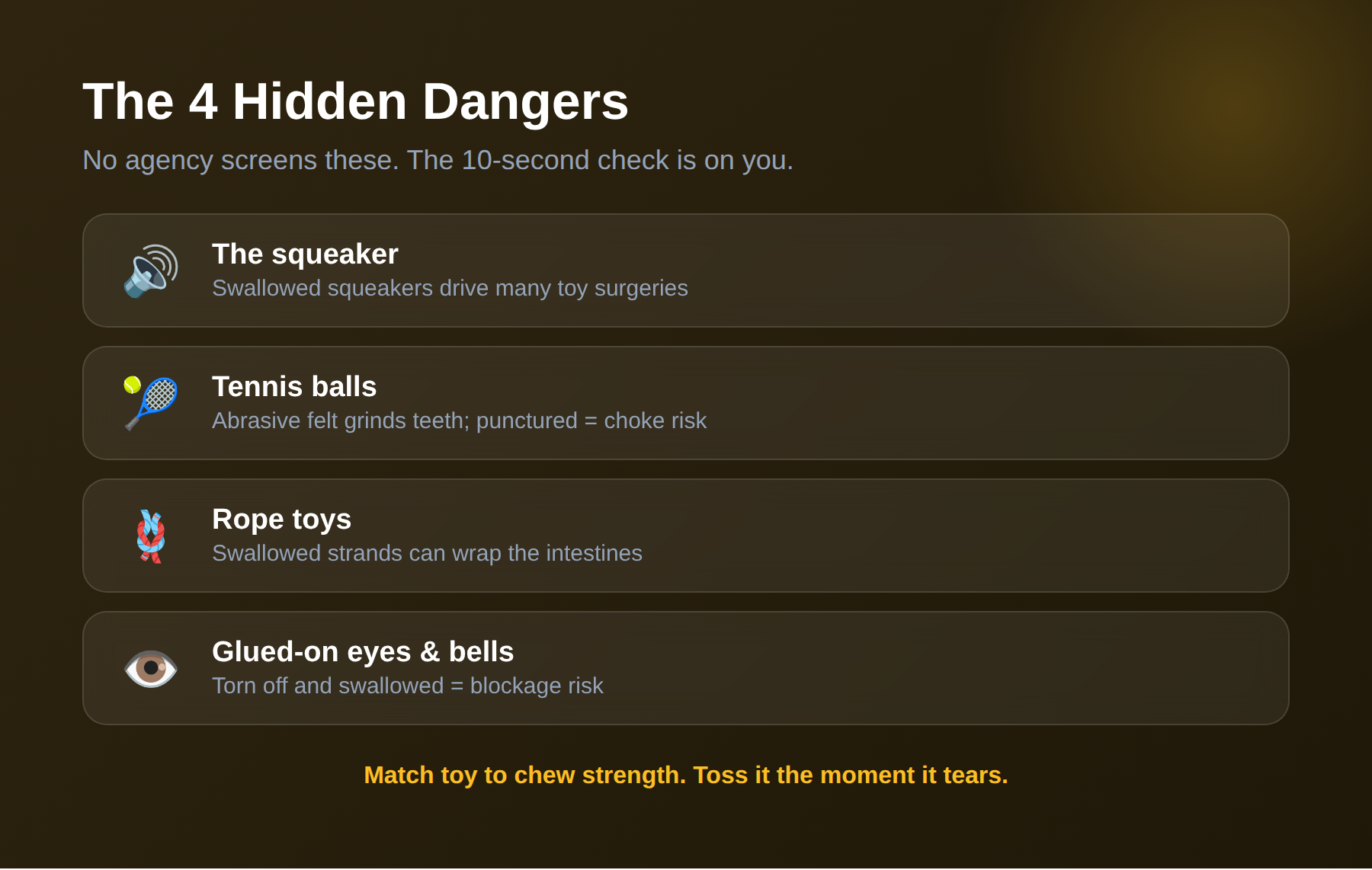
The squeaker is the big one — that little noisemaker is a prime cause of toy-related
surgeries, because a determined chewer rips it out and swallows it. Tennis balls, of all
things, are quietly rough on dogs: the abrasive felt grinds down tooth enamel over time, and a
punctured ball can become a choking hazard. Rope toys unravel into long strands that
can wrap around the intestines — a genuine, life-threatening emergency. And any glued-on
eyes, bells, or ribbons are just blockage risks waiting to be torn off.
It triggers prey drive — which is exactly why some dogs won’t stop until the toy is destroyed
and the squeaker is out. The more obsessed your dog is with the squeak, the more closely that toy
needs watching.
The Skill Worth Learning: Reading a Toy Like a Pro
You can’t outsource this. But the check takes ten seconds.
Experienced owners judge a toy the way they’d judge fresh food — with their senses and a bit of
suspicion. A strong chemical smell off a cheap imported toy? That can mean harmful residues; put it
back. Thin, brittle plastic or a seam that’s already loose? It won’t survive a real chewing session.
Trusted brands that state “non-toxic” and are transparent about materials aren’t a marketing
nicety — in an unregulated market, that transparency is the closest thing to a safety standard you
get.
How to Actually Keep Playtime Safe
🐾 The 10-second toy check
- Match the toy to the chewer. A tiny toy is a choke risk for a big dog; a hard toy can crack a small or senior dog’s teeth. Size and strength both matter.
- Look for reinforced stitching and hidden (not surface) squeakers. Double-stitched, protected-squeaker toys survive longer and choke less.
- Buy from transparent brands. “Non-toxic,” “BPA-free,” food-grade natural rubber — and skip the no-name imports.
- Toss it the moment it tears. A damaged toy isn’t a used toy — it’s a hazard. Remove it immediately.
- Supervise new toys until you know how your dog handles them, especially aggressive chewers.
The honest line: if your dog swallows a squeaker, a chunk of rope, or a toy piece —
or suddenly starts vomiting, straining, or going off food after chewing — treat it as a possible
blockage and call a vet immediately. Intestinal obstructions are emergencies, not wait-and-see
situations.
The Bottom Line
- No agency regulates pet toys — the safety check is entirely on you.
- The real hazards: swallowed squeakers, tennis-ball felt, unraveling rope, glued-on parts.
- Match toy to your dog’s size and chew strength, buy transparent brands, and toss damaged toys.
- Swallowed pieces or post-chewing vomiting = emergency vet, not wait-and-see.
Nobody inspects your dog’s toys.
So you have to.
Here to help you care smarter — not spend more. 🐾
Reading a Toy Like a Vet Would
Since no regulator is checking, the practical burden shifts to owners — and it doesn’t require expertise, just a consistent check.
The size test
A toy that can fit entirely inside your dog’s mouth, past the back molars, is a choking risk regardless of how “safe” the packaging claims it is. As a rough guide, a toy or chew should be too large to be swallowed whole and too tough to be broken into a swallowable chunk in a few minutes of determined chewing — a standard that changes considerably between a 5 kg toy breed and a 35 kg retriever, which is why “one size toy fits all dogs” claims deserve skepticism.
The material check
- Squeakers and small internal parts: the most common cause of true swallowing emergencies — a toy that’s safe intact can become dangerous the moment it’s torn open.
- Stuffing and filling: synthetic stuffing is not digestible; a dog that regularly disembowels stuffed toys is at real risk of intestinal obstruction from ingested filling, not just the squeaker.
- Soft, pliable plastics: without regulation equivalent to children’s products, some inexpensive imported toys have tested positive for phthalates and other plasticizers not intended for prolonged mouth contact — a concern that scales with how much a dog actually chews (versus fetches) a given toy.
- Rope and fabric fibers: a linear foreign body (a long strand ingested rather than a solid chunk) is a distinct and dangerous type of obstruction that can cause more internal damage than a solid swallowed object.
The ten-second habit that catches most problems early
Before handing a new toy over unsupervised, and periodically afterward: squeeze it to check for exposed squeaker mechanisms, check seams for fraying that could release stuffing, and check for any cracked or splintering hard plastic edges. Retiring a damaged toy immediately — rather than “getting a few more uses out of it” — closes the window where most toy-related emergencies actually happen.
When to call the vet, not just watch
Vomiting that doesn’t resolve within a day, straining without producing stool, visible discomfort when the abdomen is touched, or any known ingestion of a toy piece — even one you assume “probably passed” — are reasons for same-day veterinary contact rather than a wait-and-see approach. Intestinal obstructions can escalate from “watch closely” to surgical emergency faster than owners expect.
Categories that tend to hold up better — and the trade-offs
No toy is risk-free for every dog, but some categories consistently perform better in the hands of aggressive chewers:
- Solid rubber toys designed for stuffing/chewing (the KONG-style category) tend to resist tearing far better than plush or thin plastic, and don’t have a squeaker or stuffing to release. The trade-off: very hard rubber can still crack teeth in dogs who chew with real force, so size and hardness still need to match the individual dog.
- Untreated natural rubber or silicone avoids some of the plasticizer concerns of soft PVC, though “natural” alone isn’t a safety guarantee — check for a reputable manufacturer rather than assuming the material claim on the packaging.
- Plush and rope toys are genuinely higher-risk for determined chewers specifically because of stuffing and loose fibers, not because they’re inherently bad — they’re simply better suited to supervised play than to being left in a crate or bed unattended.
Matching the toy category to how your specific dog actually plays — fetches and carries versus systematically dismantles — matters more than any single brand claim.
A habit worth building: checking for recalls
Pet product recalls happen more often than most owners realize, usually for choking-hazard defects, toxic material findings, or manufacturing flaws. Periodically checking a recall list for products you already own — the same way many owners check for food recalls — costs a few minutes and catches problems that no amount of at-home inspection would reveal, since some recalled defects aren’t visible until they fail.
Supervised versus unsupervised play — the distinction that changes everything
Many toys marketed as generally safe are really only safe under supervision. A toy that’s fine while you’re in the room to intervene the moment it starts coming apart can become genuinely dangerous left in a crate overnight with the same dog. Reserve the toughest, least-destructible items for unsupervised time (a crate, an alone-at-home stretch), and save the plush, rope, or more fragile options for supervised play sessions where a problem gets caught within seconds rather than hours. This single habit shift — matching toy type to supervision level rather than treating all toys the same regardless of context — closes a large share of the gap between “toy passed inspection this morning” and “emergency vet visit this afternoon.”
A note on price and safety
A higher price tag doesn’t automatically mean a safer toy, and a bargain-bin toy isn’t automatically dangerous — but toys from established pet-product manufacturers with a track record of safety testing tend to be a more reliable bet than unfamiliar brands sold purely on price. When in doubt, the size test, material check, and ten-second habit above matter more than the brand name on the tag.
Rotating a small set of well-chosen toys, rather than leaving every toy in the basket accessible at once, also makes it easier to keep track of each item’s condition over time.
For general information only; not a substitute for veterinary care. If your dog ingests a toy part or
shows vomiting, straining, or appetite loss after chewing, seek emergency veterinary care.
Background drawn from veterinary and pet-safety references including veterinary hospital guidance and
pet-toy safety reporting.
How this article is checked. Every claim in this article goes through a structured evidence review before publishing: checked against veterinary guidelines (AAHA, WSAVA, AVMA) and peer-reviewed veterinary research, graded for how strong the evidence actually is, and screened for overstated or missing context. Articles that don't clear this review are not published. This is general educational information, not a substitute for professional veterinary advice — always consult your vet about your individual dog.
One Comment
Comments are closed.